
Depression in men rarely announces itself as sadness. It shows up as irritability, anger, risk-taking, overworking, drinking, unexplained aches, sleep loss, and pulling away from people who love him. If suicidal thoughts or a plan surface at any point, that is a crisis: call a crisis line or go to an emergency room now, not after watching a bit longer.
TL;DR:
- Men often present depression through irritability, risk-taking, substance use, and physical complaints rather than sadness, which can delay diagnosis.
- Warning signs requiring urgent attention include suicidal thoughts, severe withdrawal, reckless behavior, and statements like "what's the point."
- Support strategies focus on concrete actions like booking appointments, safety planning, and offering practical help rather than pushing for emotional conversations.
- Clinical assessment typically involves questionnaires, safety checks, and may include therapy, medication, or lifestyle changes for effective treatment.
- Male depression often mimics personality traits and physical symptoms, making awareness and targeted intervention critical for early help and risk reduction.
Male Depression Signs: The Emotional, Behavioral, and Physical Patterns
Depression in men splits into three overlapping clusters, and most men show a mix rather than one clean category.
Emotional signs exist, but they hide better in men. Instead of naming sadness, a man might describe feeling "numb," "flat," or "just tired of everything." He may lose interest in hobbies he used to protect fiercely, like weekend hockey or fishing trips, without ever framing it as low mood.
Behavioral signs tend to be louder and easier to mistake for something else entirely:
- Sudden irritability or a short fuse over minor things
- Increased risk-taking: reckless driving, unnecessary conflict, gambling
- "Escape" behaviors like compulsive overtime, obsessive gym routines, or nonstop screen time
- Drinking or substance use that quietly ramps up
- Withdrawing from friends, canceling plans, going quiet in group chats
Physical signs are often what actually gets a man into a doctor's office. Chronic fatigue that sleep doesn't fix, unexplained headaches, digestive trouble, and sexual dysfunction are common complaints tied to depression, according to provincial health guidance from MyHealth Alberta.
A familiar scenario: a man can't sleep, starts having a couple of drinks "to unwind," snaps at his kids over nothing, and tells his doctor his back has been killing him for months. None of those symptoms says "depression" on its own. Together, they're a pattern worth naming.
Why Depression Looks Different in Men
Masculine norms teach a lot of men that naming sadness is weakness, so the feeling gets rerouted into anger, work, or a bottle instead of a conversation. That rerouting isn't weakness or stubbornness. It's a learned coping style, and it's exactly what makes male depression harder to spot from the outside.
Clinical reviews back this up directly. A widely cited review published in PubMed Central found that men's depression frequently presents through externalizing behaviors, irritability, substance use, risk-taking, rather than the sadness and tearfulness clinicians are trained to look for first. That mismatch between the textbook symptom list and the real-world presentation is a major driver of underdiagnoses.
Alexithymia, a reduced ability to identify and describe one's own emotions, plays a role too. Some men genuinely don't have the internal vocabulary for "I feel hopeless." They do have words for "I feel exhausted" or "my chest hurts," which is why physical complaints often become the entry point into care, a pattern the PMC review's authors specifically flag as a diagnostic clue clinicians should probe rather than dismiss.
Here's the consequence that matters most:
- Delayed diagnosis, sometimes by years, because symptoms don't match expectations
- Higher likelihood of self-medicating with alcohol or drugs
- Elevated suicide risk when irritability and withdrawal go unrecognized as warning signs rather than personality quirks
Warning Signs That Mean It's Time to Get Help Now
Not every bad week needs a crisis response, but certain signals do.
Red flags requiring immediate action:
- Any mention of suicidal thoughts, a plan, or feeling like a burden to others
- Sudden, uncharacteristic risky behavior (reckless driving, giving away possessions)
- Withdrawal so severe he can't get out of bed, shower, or go to work
- Statements like "what's the point" or "everyone would be better off"
Rules of thumb for routine versus urgent care: symptoms lasting two weeks or more, a trend that's getting worse rather than better, and noticeable decline at work or at home all point toward needing professional evaluation soon, even without an emergency.
Pro Tip: If you're worried, ask the direct question: "Are you having thoughts of suicide?" Asking does not plant the idea. It opens the door. If the answer is yes and there's a plan, call 911 or a crisis line immediately and stay with him until help arrives.
Removing access to firearms, excess medication, or other means of self-harm, when it's safe to do so, is one of the most effective things a family member can do in the hours after a crisis surfaces.
How to Support a Man Who's Showing These Signs
The opening line matters more than people think. "You've seemed really wound up lately, and I'm not trying to fix it, I just want to know how you're doing" lands better than "You need to talk to someone." The first invites; the second sounds like an accusation.
Once he's talking, resist the urge to problem-solve immediately. Reflect back what you're hearing ("That sounds exhausting to carry alone") instead of jumping to advice or minimizing with "at least you have a good job."
Concrete, logistical help often works better than conversation alone:
- Offer to book the first appointment yourself, or sit with him while he calls
- Ask if he'd like company at the first visit, some men will go if they're not going alone
- Help build a simple safety plan if risk has come up, including who to call and what to remove from the house
- Loop in an employer's EAP program or a family doctor if he's resistant to therapy specifically
Pro Tip: Supporting someone through depression is draining. Set your own limits, get your own support, and remember you can't out-love someone else's depression. You can only make the path to help shorter. Our guide on supporting a partner through depression covers this in more depth.
What Treatment and Assessment Actually Look Like
A first appointment, whether with a family doctor or a therapist, usually starts with a screening questionnaire (often something like the PHQ9), a conversation about how long symptoms have lasted, and a direct safety check for suicidal thoughts. None of it is designed to catch him out. It's designed to map the problem accurately.
From there, care paths typically include:
- Psychotherapy, particularly cognitive behavioral therapy or interpersonal therapy, which targets the thought patterns and relationship stress feeding the depression
- Medication, often an antidepressant, prescribed and monitored by a physician
- Combined care, therapy plus medication, which shows strong outcomes in clinical reviews of depression treatment
- Lifestyle supports, sleep repair, movement, and reduced alcohol use, layered alongside formal treatment
Sessions are confidential, and in Canada, coverage depends on the plan, some employer benefits cover psychotherapy directly, while others require a doctor's referral for partial reimbursement. Our guide to finding a depression therapist walks through what to expect from search to first booking, and our overview of psychotherapy for depression explains what a course of treatment usually involves.
A Note From Dewy Counselling on Male-Presenting Depression
Some therapists see this exact pattern often: a man who books a session for "stress" or "sleep issues" and turns out to be carrying depression that's been misread as a personality problem for years. Sessions start with an honest assessment rather than assumptions about what depression is supposed to look like.
Treatment may include behavioral activation (rebuilding routines that create momentum), safety planning when risk is present, and relational work when a partner or family is affected, since male depression rarely stays contained to one person's mood.
When booking, it's worth asking:
- What modality (in-person or online) fits your schedule
- Whether the therapist has experience with male-specific presentations
- What confidentiality looks like if a partner or employer is involved
If depression is straining a relationship, couples counselling can address that alongside individual work. Explore psychotherapy services or visit Dewycounselling to book an assessment.
The Uncomfortable Truth About How We Talk to Men About Depression
Most advice about male depression stops at "encourage him to talk about his feelings," which sounds reasonable and helps almost nobody. Plenty of men genuinely cannot locate the words for what they're feeling in the moment you're asking. Alexithymia isn't an excuse men hide behind. It's a real gap in emotional vocabulary that research on male-specific depression keeps surfacing, and pushing harder for a feelings conversation just teaches him to dodge you faster.
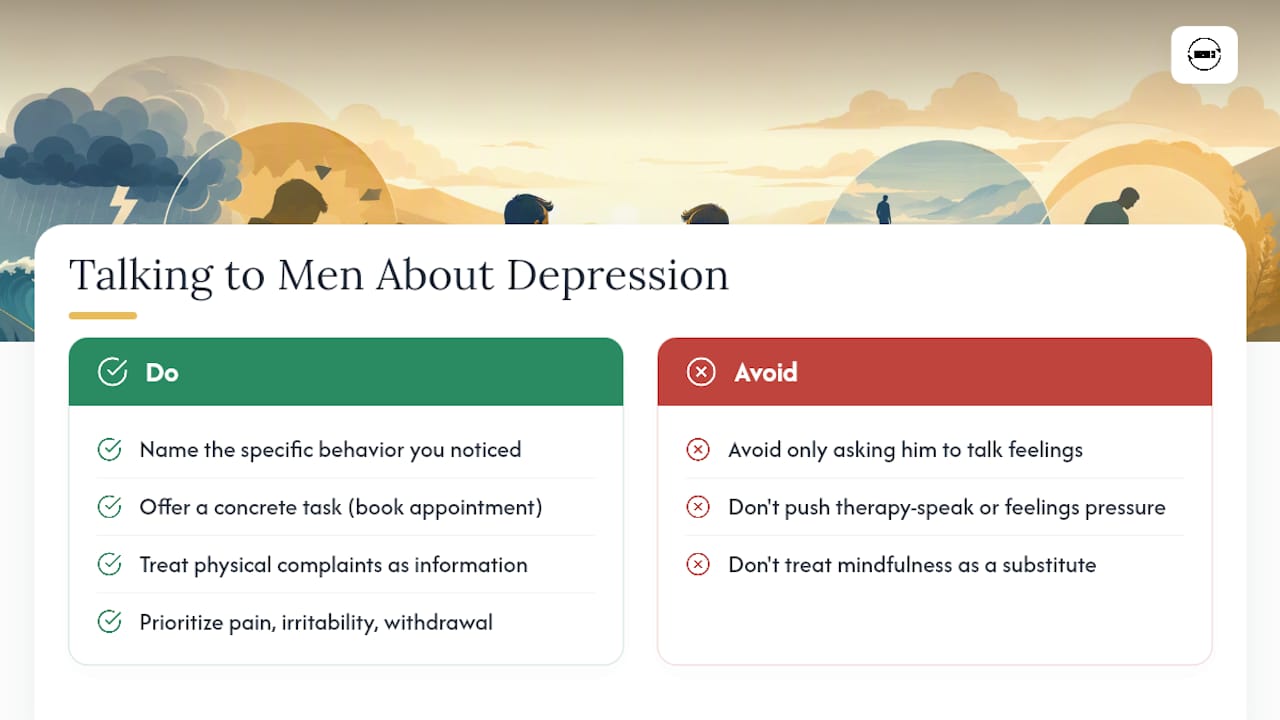
What actually works looks less like therapy-speak and more like logistics: naming the specific behavior you've noticed, offering a concrete task (a booked appointment, a ride there), and treating physical complaints as information rather than a distraction from the "real" problem. A man who mentions chronic back pain and irritability in the same breath isn't avoiding the topic of depression. He might be describing it in the only language he has.
The mindfulness practices covered in Viridos's piece on mindfulness for men can support resilience alongside clinical care, but they're a supplement, not a substitute, for proper assessment when risk factors are present. Prioritize the physical complaint, the irritability, the withdrawal, over waiting for a tearful confession that may never come.
— Wayne Dewhurst