
If your partner routinely denies things you know happened, calls you "too sensitive" when you raise a concern, or slowly cuts you off from friends who validate your reality, you are likely dealing with gaslighting. The immediate move is simple: write down what happened, with the date and exact words used, and tell one trusted person or a mental-health professional today. You don't need to have every answer before you reach out.
TL;DR:
- Gaslighting involves repeated tactics like denial, blame-shifting, and trivializing feelings, which erode your perception of reality over time.
- Documentation of specific incidents, dates, and messages is crucial for validating your experience and protecting yourself from ongoing manipulation.
- Patterns of gaslighting often include intermittent kindness, projection, and discrediting, making it difficult to recognize without noticing the repetition.
- The emotional toll can lead to anxiety, depression, and self-doubt, which may persist even after ending the relationship, requiring trauma-informed therapy.
- Setting clear boundaries and seeking professional support are essential steps for safety and clarity, especially when dealing with manipulative partners or environments.
Key Signs of Gaslighting in a Relationship
Gaslighting rarely announces itself. It builds through small, repeated moments that each feel deniable on their own, which is exactly what makes the pattern so disorienting. Cleveland Clinic defines it as behavior that has to repeat over time to count as gaslighting rather than a single bad argument.
Here are the tactics that show up most often, ranked roughly by how diagnostic they are when they repeat.
- Flat denial or rewriting history. "That never happened" or "I never said that," delivered with total confidence even when you have a text message proving otherwise. This is the core move because it directly attacks your memory rather than your opinion.
- Trivializing your feelings. "You're too sensitive" or "You're overreacting" reframes a legitimate reaction as a personal flaw, so you start policing your own emotions instead of addressing the behavior that caused them.
- Blame-shifting. Somehow every disagreement ends with you apologizing. "I only said that because you made me" flips responsibility so cleanly you may not notice it happening.
- Withholding and stonewalling. Silence used as a weapon, refusing to explain or engage until you concede the point just to end the standoff.
- Projection and discrediting you to others. Accusing you of the exact behavior they're doing, then telling friends or family you're "unstable" or "dramatic" so your future complaints land as proof of instability rather than evidence.
- Intermittent reinforcement. Cruelty followed by unexpected warmth and affection. The kindness after harm is what keeps hope alive and makes leaving feel unnecessary, even premature.
- Using loved ones as ammunition. "Your friends all think you're unstable" isolates you by making your own support network sound unreliable, according to reporting on isolation tactics in manipulative relationships.
- Repeated minimization and a recognizable "script." The same handful of phrases surface every time you push back, almost like a rehearsed defense.
Pro Tip: A single instance of any one item on this list is not gaslighting. What matters is whether the same tactic shows up again and again, especially paired with denial when you bring up the pattern itself.
How Gaslighting Differs from a Normal Disagreement
Every couple argues, misremembers a detail, or gets defensive under stress. Gaslighting is different because it's a pattern, not an event, and it carries an imbalance of power rather than two people trying to be understood. Ordinary conflict involves both partners eventually acknowledging the other's version of events, even if they disagree on interpretation. Gaslighting involves one partner consistently refusing to acknowledge the other's version at all.
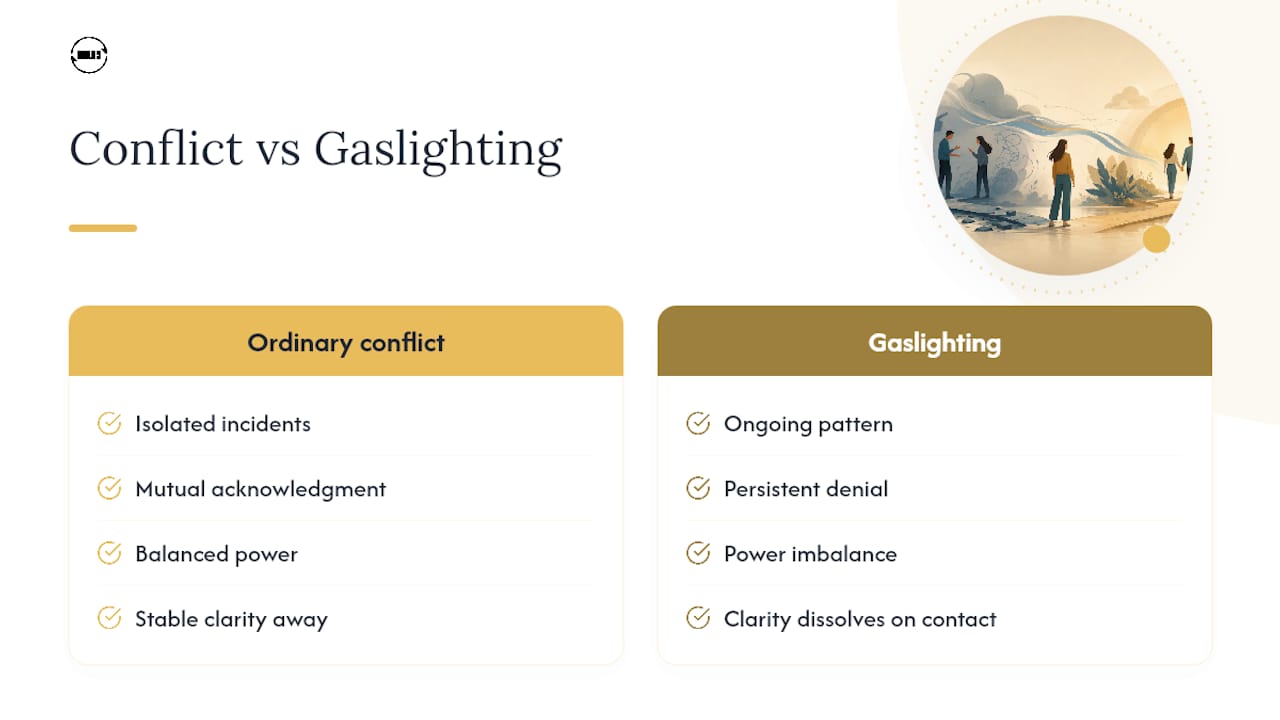
A useful way to test this is what clinicians sometimes call the clarity test: your perception of the relationship feels sharp and reasonable when you're away from your partner, then dissolves into confusion within minutes of contact. That shift, described in guidance on relationship abuse patterns, points to manipulation rather than a simple misunderstanding.
This is also why defensive documentation matters so much. Keeping dated notes or saved messages gives you something stable to check your memory against, so the confusion doesn't get to win every time.
Real Phrases and Scenarios to Watch For
The exact wording gaslighters use tends to repeat, which makes it easier to recognize once you've heard it named. Practitioner write-ups describing real-world gaslighting examples list phrases nearly every survivor recognizes instantly.
- "That never happened. You're imagining things."
- "You're being dramatic. It wasn't that big of a deal."
- "I never said that. You must have misheard me."
- "Everyone agrees you overreact. Even your mom thinks so."
- "If you weren't so sensitive, we wouldn't have this problem."
Picture the scenario: your partner raises their voice at dinner in front of friends, then later insists calmly that it never happened and implies you're too anxious to remember things correctly. A screenshot of the group chat where a friend mentions the outburst becomes an anchor. It's not about winning an argument. It's about protecting your grip on what's real.
The Mental Health Toll of Sustained Gaslighting
Chronic exposure to this kind of manipulation wears down more than your confidence in one relationship. Research links prolonged gaslighting to anxiety, depression, and a persistent self-doubt that researchers sometimes call epistemic harm, a breakdown in your basic trust in your own perception, according to a peer-reviewed review of psychological impacts.
These effects don't necessarily end when the relationship does. Many survivors carry a lingering habit of second-guessing themselves into future relationships, friendships, and even workplace decisions. That's not a character flaw. It's a learned survival response to an environment that repeatedly punished trusting your own judgment, and it typically responds well to trauma-informed therapeutic support.

Practical Next Steps: Document, Set Boundaries, Stay Safe
Once you recognize the pattern, the goal shifts from proving anything to your partner and toward protecting yourself. These steps work whether you're still deciding what to do or already planning your next move.
- Document safely. Keep a private, locked note or journal with dates, direct quotes, and what happened right before and after. Save relevant texts or emails somewhere your partner can't access or delete.
- Use short, enforceable boundary scripts. "I remember it differently, and I'm not going to debate my memory" ends the loop without inviting a longer argument. Cleveland Clinic notes that disengaging tends to work better than trying to reason with an active gaslighter.
- Build a safety plan if needed. If you feel physically unsafe or increasingly controlled, prioritize a safety plan over any attempt at reconciliation.
- Reach out for professional support. A therapist offers a neutral space to sort fact from manipulation, something public health guidance frames as a clarity tool, not a judgment on your relationship.
- Consider Dewycounselling as a direct option. Individual sessions can help you rebuild trust in your own judgment before deciding what happens with the relationship. Details are on the therapy services page.
Pro Tip: Store your documentation somewhere your partner has zero access to, a separate email account or a cloud note with its own password. Gaslighters sometimes search phones specifically to erase the evidence you're building.
Gaslighting Beyond Romantic Relationships
Romantic partners aren't the only ones capable of gaslighting you, and recognizing the pattern in one setting often makes it easier to spot in another. The mechanics stay the same across contexts: repeated denial, trivializing, and blame-shifting designed to erode your confidence in your own read of events.
In families, gaslighting frequently looks like a parent or sibling insisting a painful childhood memory "never happened that way," or a relative rewriting a recent conflict so you end up apologizing for pointing it out. Because family relationships carry decades of history and loyalty pressure, this version can be especially hard to name, since disagreeing with a parent's version of events can feel like a betrayal rather than a boundary.
At work, gaslighting often takes a more procedural shape: a manager denying a previous instruction, taking credit for your work while implying you misremembered who did what, or telling colleagues you're "difficult" to preempt any complaint you might raise. Reporting on workplace gaslighting points to the same isolation and credibility-undermining tactics seen in romantic relationships, just dressed in professional language.
Whichever setting you're navigating, the same documentation habits and boundary language apply. The relationship label changes. The tactic doesn't.
A Therapist's Perspective on What Comes Next
If you recognize yourself in this article, that recognition is not weakness. It's clarity returning. Couples therapy can help with genuine communication breakdowns, but when gaslighting is intentional, your safety and individual support usually need to come first. A professional assessment can help you tell the difference.
— Wayne Dewhurst
How Dewycounselling Can Help You Rebuild Clarity
Recognizing gaslighting is the hard part. Getting support shouldn't add another layer of confusion, and that's where Dewycounselling's approach differs from figuring this out alone or waiting for a crisis to force the issue: you get a therapist trained in relationship dynamics, not just general counseling, working with you at a pace you control.

Individual sessions give you space to sort fact from manipulation without your partner in the room, an option that matters when trust in your own memory has taken a hit. In-person and online sessions run $175 an hour, with a mobile option at $225 an hour if getting to an office isn't realistic right now. Couples work is available too, but only where it fits: our couples therapy and mediation services page explains when joint sessions make sense and when individual safety planning should come first.
Your first appointment typically covers what's been happening, how it's affecting you day to day, and a plan for the next few sessions, whether that's building boundary skills, processing what you've documented, or simply having a place to be believed. Book a session when you're ready to start.
Sources
This article draws on Cleveland Clinic's overview of gaslighting, Gottman Institute's examples of gaslighting, a peer-reviewed study on psychological impacts, and Government of Canada mental health resources. For related reading on relationship recovery, see Healing from a Toxic Relationship: A Practical Recovery Roadmap.
This article is general information, not a substitute for advice from a qualified doctor. Consult a qualified healthcare professional about your own circumstances before acting on anything here.
- Gaslighting: Definition & How To Spot It — Cleveland Clinic
- Mental health: Get help — Government of Canada
- 10 real-world examples of gaslighting in relationships — The Gottman Institute
- Peer-reviewed article on psychological impacts — PMC
FAQ
What are 10 signs that you might be being gaslit?
Common signs include flat denial of events, being told you're "too sensitive," blame-shifting, stonewalling, projection, isolation from friends and family, intermittent kindness after cruelty, feeling confused specifically after talking to your partner, constantly apologizing without knowing why, and doubting your own memory more than you used to. If several of these repeat over time, Cleveland Clinic considers that a strong pattern worth addressing.
How do you expose a gaslighter?
Focus less on "exposing" them publicly and more on documenting the pattern with dates, direct quotes, and saved messages. Sharing that documentation with a trusted friend or therapist builds an outside reality check, which is often more useful than a confrontation the gaslighter will simply deny.
Can people stop gaslighting?
Change is possible in cases where the behavior comes from poor conflict skills rather than a deliberate need for control, especially with sustained individual therapy. When the pattern is intentional and repeated despite being named, safety planning for the person being gaslit matters more than waiting for change.
What are examples of gaslighting in relationships?
Examples include a partner insisting "that never happened" after a documented argument, calling you dramatic for raising a valid concern, or telling mutual friends you're unstable to undercut your credibility before you've said anything. The Gottman Institute catalogs similar recurring scenarios that most survivors recognize immediately.
Is my partner gaslighting me or are we just bad communicators?
The clearest difference is repetition and outcome: poor communicators eventually meet in the middle, while a gaslighting partner consistently refuses to acknowledge your version of events at all. If clarity returns when you're apart but disappears during contact, that pattern points toward manipulation rather than a simple communication gap.