
Prioritize combined employee and manager training aligned with the National Standard of Canada for Psychological Health and Safety in the Workplace. Programs like The Working Mind, Being a Mindful Employee, and CMHA's Psychological Health & Safety courses give Canadian employers evidence-based options that fit almost any budget. None of it works alone, though. Training needs to sit inside a broader policy and measurement plan to hold.
TL;DR:
- Most programs range from 1.5 hours for baseline awareness to 8 hours for managerial certification, often spread across multiple sessions for better retention.
- Costs vary from free for basic courses to several thousand dollars for comprehensive, sector-specific, or train-the-trainer certifications.
- Effective training should be paired with clear policies, ongoing measurement, and clinical referral pathways to ensure lasting impact.
- A single session provides awareness but needs to be integrated into a broader systematic approach for meaningful long-term outcomes.
- Small and medium organizations benefit from focused, clinician-led workshops plus immediate access to follow-up support rather than solely relying on awareness courses.
What Employee Mental Health Training Programs Are Available in Canada?
Canadian employers do not lack for options. The gap is usually knowing what each program actually delivers.
The Working Mind (TWM), developed by the Mental Health Commission of Canada, is the most widely recognized name in the space. It offers separate employee and manager tracks, plus a train-the-trainer pathway for organizations that want to run sessions internally. TWM leans heavily on scenario-based lessons and lived-experience videos rather than lecture slides, which is part of why it holds attention better than a typical compliance module.
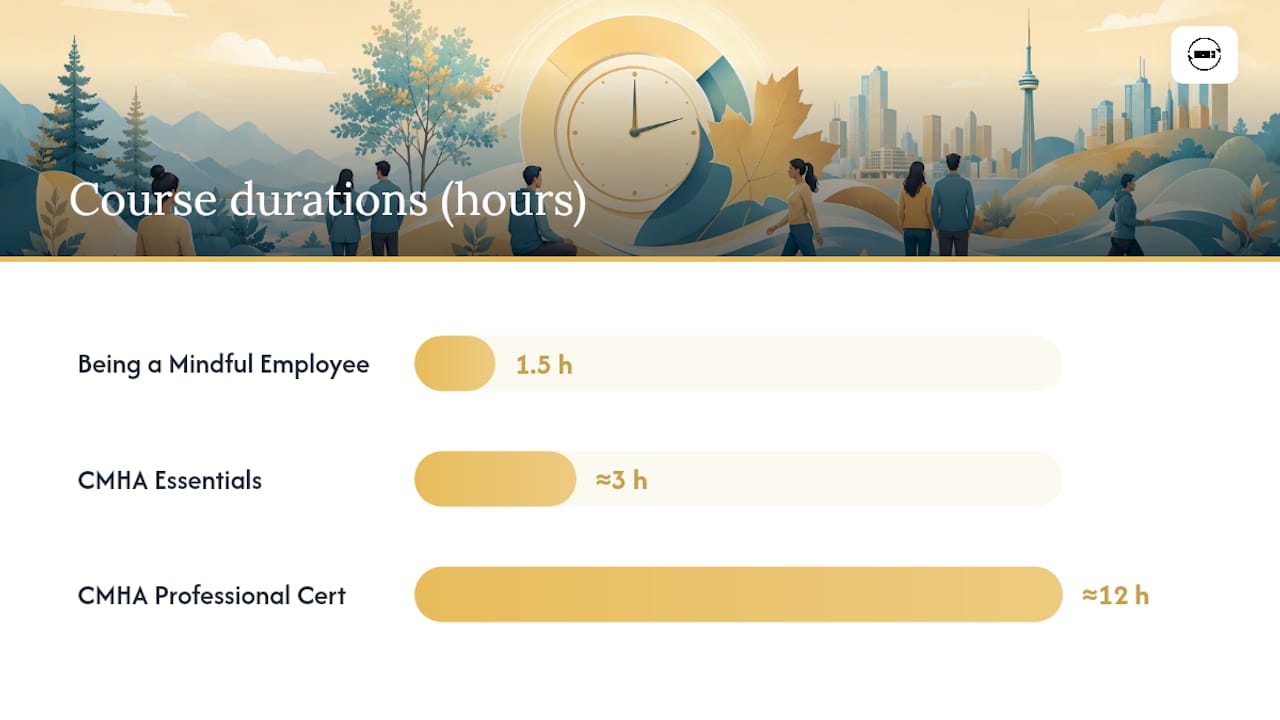
Being a Mindful Employee, built by the Canadian Centre for Occupational Health and Safety (CCOHS), is a free, 1.5 hour orientation that walks through the 13 psychosocial factors named in the National Standard. It is the easiest on ramp for an organization that has never touched formal training and wants every employee to have baseline literacy before anything more structured begins.
The Canadian Mental Health Association (CMHA) runs two tiers worth knowing: an Essentials course (roughly 3 hours) for general awareness, and a Professional Certificate (about 12 hours across four half days) aimed at people who will actually help implement the National Standard inside their organization.
The Workplace Safety & Prevention Services (WSPS) catalog rounds things out with sector-specific sessions, often useful for manufacturing, construction, and other higher-risk workplaces already managing occupational health and safety obligations.
Cost cues vary widely:
- Being a Mindful Employee: free for individual learners
- CMHA Essentials: modest per-person fee, often under $100
- TWM employee/manager courses: mid-range per-seat pricing, discounted for group bookings
- Train-the-trainer certifications: higher upfront investment, lower cost per employee over time
Most major programs offer English and French delivery, which matters for organizations operating across provinces.
How Long Do These Courses Take, and Who Should Take Them?
Duration is where a lot of HR budgets get miscalculated. Here is what the time commitment actually looks like across the main programs:
- Being a Mindful Employee: about 1.5 hours, self-paced, suitable for every employee regardless of role.
- The Working Mind (employee track): roughly 4 to 4.5 hours, typically split into two sessions rather than one sitting.
- The Working Mind (manager track): about 8 hours, reflecting the added weight of coaching skills, difficult conversations, and accommodation basics managers need.
- CMHA Professional Certificate: about 12 hours delivered across four half days, built for people who will lead implementation, not just attend a session.
- Train-the-trainer certification: typically a multi-day commitment, often cited around five days, plus ongoing facilitation support afterward.
Spreading sessions across two or three shorter blocks tends to beat a single all-day cram, mainly because retention drops fast when people sit through eight hours of emotionally heavy material in one stretch.
External facilitators bring impartiality and specialist depth, especially for a first rollout, as discussed in this practical guide for Australian churches addressing stigma and community supports. In-house trainers, once certified, let a larger organization move faster and cheaper on repeat cohorts. Most Canadian employers land on a hybrid: bring in an outside facilitator for the pilot, then train internal champions once the program proves its value.
Pro Tip: Book manager training before employee training rolls out broadly. A manager who has not yet learned how to respond to a disclosure is the weakest link in the whole system, no matter how good the employee-facing course is.
How Should Employers Choose and Roll Out Mental Health Training?
Vetting a training vendor is not that different from vetting any other professional service, except the stakes are personal. A handful of criteria separate a program that changes behavior from one that just checks a box:
- Does the curriculum explicitly map to the National Standard's 13 psychosocial factors?
- Does it use lived-experience content and scenario-based practice rather than lecture-only delivery?
- Can the vendor point to any measured outcomes, even directional ones, from past clients?
- Will they customize content for your sector, size, or workforce demographics, as CMHA guidance on tailoring initiatives recommends?
- Are trainer credentials and clinical backgrounds available on request?
- What happens to participant data, and is there a follow-up support plan after the session ends?
Questions worth putting directly to a vendor: What does success look like at 90 days? Can we see two references from organizations our size? What is the incremental cost of a train-the-trainer license versus per-seat group pricing? Do you offer French-language delivery?
A realistic timeline runs pilot, then evaluation, then phased rollout, then follow-up coaching, typically over two to three fiscal quarters rather than a single kickoff event. Budget ranges swing widely by headcount and format, from a few thousand dollars for a small-team pilot to five figures for enterprise-wide train-the-trainer certification.
Watch for red flags: a vendor with no measurement plan, or one that promises culture change from a single 90-minute session. Given that poor workplace mental health support costs the Canadian economy an estimated $17 billion a year in lost productivity, the financial case for doing this properly, rather than cheaply, is not subtle.
Does Mental Health Training Actually Change Outcomes?
The honest answer is "somewhat, and it depends what you pair it with." A 2023 umbrella review of workplace mental health interventions found small-to-moderate benefits across many universal programs, with low certainty for specific long-term outcomes like sustained absenteeism reduction or turnover.
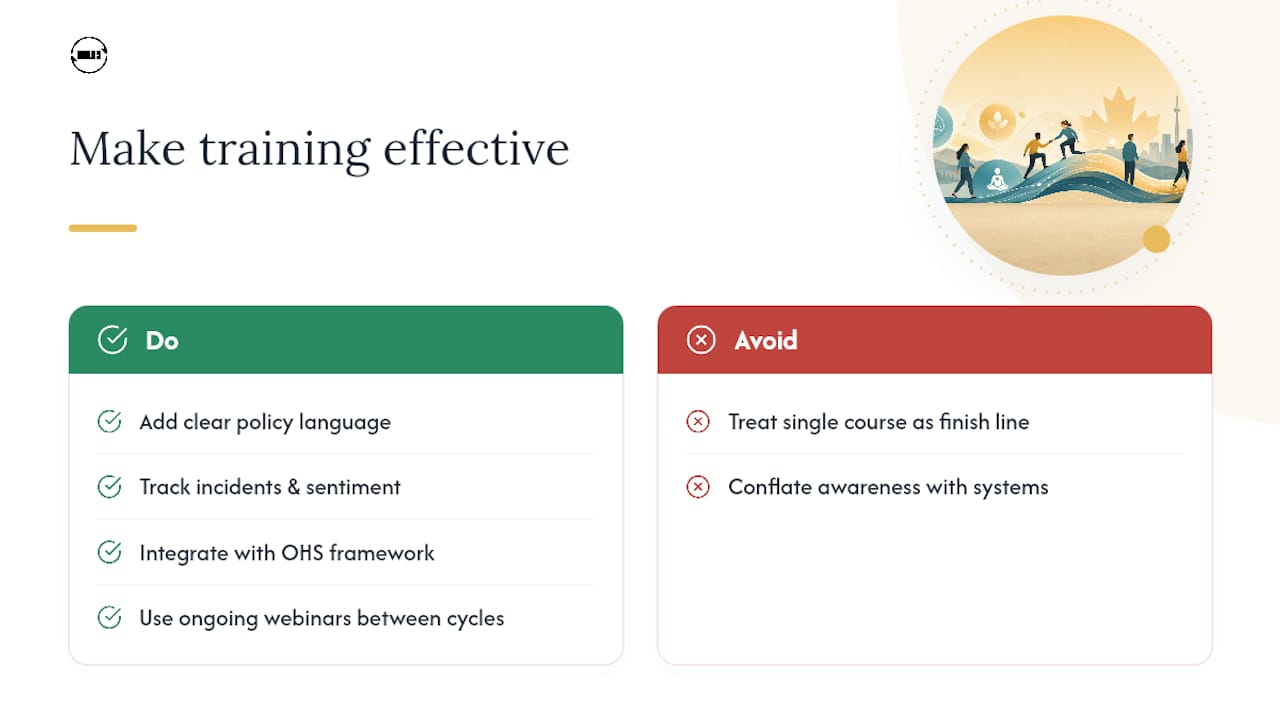
That is not a reason to skip training. It is a reason to stop treating a single course as the finish line.
Awareness training and a management-system approach are not the same thing. The National Standard was built around ongoing psychological health and safety practices, not a one-time seminar, and research on workplace psychological safety consistently points to systems, not sessions, as the durable lever.
Practically, that means pairing any course with clear policy language, a way to track incidents or sentiment over time, and integration with your existing occupational health and safety framework. The Government of Canada's mental health learning hub offers ongoing webinars for organizations that want to keep the conversation active between formal training cycles, rather than letting it go dormant until the next mandatory session.
A Practitioner's View on Training Small and Medium Canadian Workplaces
Most small and medium Canadian employers do not need an eight-hour manager program on day one. They need a focused, clinician-led workshop that teaches managers how to recognize distress and respond without making it worse, followed by real coaching once the initial session ends.
The mistake I see most often is treating training as complete once the workshop finishes. A three-hour session builds awareness. It does not build a referral pathway. Effective programs pair short sessions with a clear route to clinical support and a structured prevention plan, so a manager who spots a struggling employee knows exactly what to do next, not just what to notice.
— Wayne Dewhurst
How Dewy Counselling Supports Employer Mental Health Training
Dewy Counselling is the practical alternative to a one-and-done corporate seminar. Some providers hand you a certificate and disappear, but manager workshops paired with an actual clinical referral pathway are more effective. Employees who need more than awareness training get a direct line to licensed therapists, not a pamphlet.
Our services relevant to employers include shortened, clinician-led manager training, custom team seminars built around your sector and workforce, and psychotherapy referral pathways for employees who need follow-up care beyond a single session. A pilot typically starts with one manager cohort and a defined follow-up coaching window, allowing measurement of engagement before scaling to the full organization.
If your team is ready to move past a one-time awareness course, visit Dewy Counselling to discuss a pilot workshop and see what a realistic rollout timeline looks like for your workforce size.
This article is general information, not a substitute for advice from a qualified doctor. Consult a qualified healthcare professional about your own circumstances before acting on anything here.
Sources
- The Working Mind — Mental Health Commission of Canada
- Umbrella review on workplace mental health interventions (PubMed)