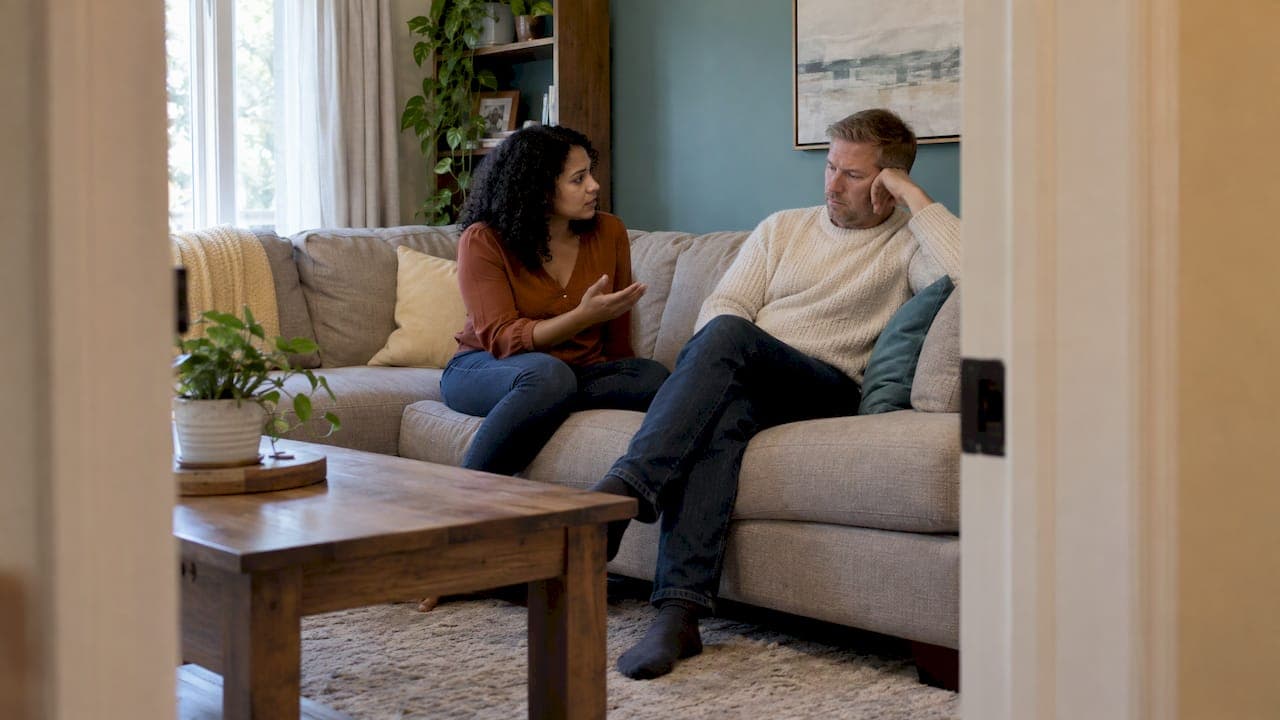
Emotional neglect in a marriage is the slow, quiet pattern of your feelings, needs and good news going unnoticed or unanswered by the person closest to you. There is often no fight, no betrayal and no single event to point to. There is just a growing sense of being alone while sitting next to your spouse. The encouraging part is that this pattern can be named, talked about and changed, and you do not have to wait until the distance feels permanent to start.
TL;DR
- Emotional neglect means a partner's emotional needs and bids for support repeatedly go unseen or unanswered, even though the marriage looks intact from the outside.
- Common signs include feeling lonely beside your spouse, conversations that are all logistics, and no longer being the first person each of you wants to tell your news to.
- Childhood emotional neglect and life transitions such as an empty nest can both contribute, but neither means the marriage is failing.
- Start with one calm, specific conversation about your own experience rather than a list of your partner's faults.
- If the distance persists, couples therapy gives you a structured, supportive place to rebuild connection.
What emotional neglect in a marriage actually means
Most of us picture a troubled marriage as a loud one. Emotional neglect is the opposite. It is what happens when the signals that say "I need you," "look at this," or "I had a hard day" meet a shrug, a distracted nod or silence, again and again. Over time, the person sending those signals learns to stop sending them.
Psychology Today's writing on this topic describes it as the absence of emotional attunement and connection, which is why it is so hard to spot: you are trying to see what is not there. Nothing dramatic happened, so nothing seems to need fixing. Yet the loneliness is real.
It helps to think of it like a plant that is never watered. Nobody attacked it. Nobody did anything cruel. It simply did not receive what it needed, and eventually it wilted. Emotional neglect is rarely about a spouse who does not care. More often it is about two people who have lost the habit, or never learned the skill, of tuning in to each other.

How it differs from ordinary conflict
Every couple argues about money, chores, in-laws and schedules. Conflict, even heated conflict, is a form of engagement: both people still care enough to push.
Emotional neglect looks different:
- Conflict is about a specific issue and usually ends with some kind of repair, even an awkward one.
- Emotional neglect is a pattern of absence. Feelings are not argued about because they are not discussed at all.
There is a twist worth knowing. Dr. Jonice Webb, who specializes in childhood emotional neglect, argues that couples who avoid conflict entirely may be preventing mutual trust and deeper emotional connection from growing. A marriage with no arguments is not automatically a close one. Sometimes the calm is the symptom.
If you want a closer look at what healthy closeness feels like, our guide to what emotional intimacy is is a good companion to this article.
Signs of emotional neglect in a marriage
No checklist can diagnose your marriage, and one item on a list does not mean something is wrong. What matters is whether several of these feel familiar and whether they have lasted for months rather than a rough week. Based on the red flags described in Psychology Today, here is what to look for.
You feel alone when your partner is in the room
This is the most common sign and the most painful. You are physically together, perhaps on the same couch, and still feel as though you are on your own. If you have ever typed "feeling alone in marriage" into a search bar late at night, this is probably the experience behind it.
Your conversations are mostly logistics
Who is picking up the kids, what is for dinner, whether the furnace guy is coming on Thursday. Practical talk is necessary, and every household has plenty of it. The warning sign is when it crowds out everything else: how you are feeling, what worries you, what you are looking forward to.
Warmth feels awkward
A compliment, a long hug or a moment of vulnerability feels strange or even embarrassing, as if you are out of practice. Closeness that used to be natural now takes effort.
You are no longer each other's first call
When something good or hard happens, you think of a friend, a sibling or a coworker before your spouse. The same source notes that partners in emotionally neglectful relationships often stop being the first person each wants to reach out to, whether they are celebrating or struggling.
Hard feelings get avoided
One or both of you changes the subject, jokes, goes quiet or leaves the room when something emotional comes up. Over time, topics become off limits without anyone ever deciding that.
Resentment builds without a clear reason
When needs go unspoken or unmet, they do not disappear. They tend to turn into irritation, withdrawal or a low hum of resentment. Psychology Today notes that adults affected by emotional neglect may feel distant and alone in their marriages, and that avoided feelings and needs can feed resentment.
If several of these sound like your home, our article on signs your relationship needs therapy can help you weigh what to do next.
Why you can feel so alone in a marriage
Loneliness inside a marriage can feel more confusing than loneliness on your own. You have a partner, so you wonder what right you have to feel this way. That self-doubt often keeps people quiet for years.
Loneliness within a committed relationship is not ingratitude and it is not a character flaw. It is a signal that a basic need, being known and responded to by the person you chose, is not being met. Many people also carry it privately because they assume their spouse would be hurt or defensive, which means neither person ever learns the other is struggling too.
It is also worth saying that your partner may be lonely in exactly the same way. Emotional neglect is often mutual and unintentional: two people, both waiting for the other to reach first.
Where it can come from
Childhood emotional neglect
Some people grew up in homes where feelings were rarely discussed, acknowledged or taken seriously. Nobody was necessarily unkind. Emotions were simply not part of the family conversation. As adults, these people often have limited emotional awareness and vocabulary, and Psychology Today notes that this can make deep, personal connection difficult.
This matters for how you approach your spouse. A partner who seems cold or checked out may not be refusing to engage. They may genuinely not know how, because no one showed them. That does not make the pain of being on the receiving end any smaller, but it changes the question from "why don't you care?" to "how can we learn this together?"
Our guide to attachment styles in couples explains how early experiences can shape the pursue and withdraw cycle many couples fall into.
Busy seasons that never end
Young children, shift work, caring for aging parents, a demanding career: marriages often drift because the calendar leaves no room, not because anyone stopped loving anyone. Attention goes to whatever is loudest, and a quiet relationship rarely is.
Unresolved hurts and sexual distance
If an old betrayal, a broken promise or a long stretch without physical intimacy has never been properly addressed, emotional distance often grows around it like scar tissue. Some couples find that the emotional and sexual sides of the relationship fade together. If that sounds familiar, see our low-pressure guide to sexless marriages in Canada.
Empty nest and marriage: when the house gets quiet
For many couples, the years of raising children are also the years when the marriage runs on autopilot. Then the last child moves out and the two of you are left across the kitchen table with a lot of silence.
The Mental Health Commission of Canada describes the empty-nest transition as one that can be difficult and bring sadness or disorientation, while also offering a chance to renew relationships, including with your partner. The same piece points out that the idea of "empty nest syndrome" has largely been debunked as a cultural myth, and that most parents find the change positive once the day-to-day responsibilities lift.
What does that mean for your marriage? Two things can be true at once:
- The empty nest is not a crisis by default, and many couples enjoy it.
- It can reveal a distance that was already there but hidden behind school runs, hockey schedules and homework.
If the quiet feels uncomfortable, treat it as information rather than a verdict. You may be meeting your spouse again after a long time, and that deserves curiosity. Start small: a weekly walk, a meal without screens, a question you have not asked in years such as "What do you want the next ten years to look like?"
How to talk to your spouse about it
The way you open this conversation matters more than the exact words. Healing from emotional neglect, according to Psychology Today, involves taking ownership of your own emotional awareness and sharing your experience openly with your partner. That is a useful frame: you are inviting your spouse in, not putting them on trial.
A simple approach
- Pick your moment. Not during an argument, at bedtime or when either of you is exhausted. Try a quiet weekend morning or a walk.
- Start with your own experience. "I've been feeling lonely lately and I miss us" lands very differently from "You never listen to me."
- Be specific and gentle. Name one or two moments: "When I told you about my day on Tuesday and the conversation moved on, I felt invisible."
- Say what you want. A request is easier to answer than a complaint. "Could we have twenty minutes each evening without phones?"
- Listen to understand. The Canadian Psychological Association notes that couples who state their needs clearly and listen to understand their partner can strengthen intimacy and trust over time.
- Expect it to take more than one conversation. Your spouse may need time to absorb what you have said, especially if feelings were never discussed in their family.
If you are the partner who has been told you are "distant," try to hear it as an invitation. You do not have to know the right words. "I didn't realize you felt that way, and I want to understand" is a very good start.
For practice that goes beyond the first conversation, try the communication exercises for couples or our list of practical exercises to improve communication with your partner. When talks get heated, our five-step playbook for conflict resolution in marriage offers a calmer path.
Small habits that rebuild closeness
Reconnection is rarely a grand gesture. It is the accumulation of small moments in which one of you reaches and the other responds. These are practical ways to build that habit:
- Turn toward small bids. When your spouse says "look at this" or sighs heavily, pause and respond, even briefly.
- Ask one real question a day. Not "How was your day?" but "What was the best and hardest part of today?"
- Name your own feelings out loud. If this is new for you, start with simple words: tired, anxious, proud, disappointed.
- Share good news first with each other. Rebuild the habit of being each other's first call.
- Protect a regular check-in. Fifteen to twenty minutes weekly, with no problem-solving agenda, can be enough to keep small hurts from accumulating.
These steps feel simple, and they are. They are also easy to skip, which is why a regular time set aside tends to work better than good intentions.
We have sat with many couples who arrived believing they had simply grown apart. When we slow things down, what we usually find is two people who still care but have stopped knowing how to reach each other. Emotional neglect is a relational wound, and like a physical wound it heals best when it is tended early and gently, not ignored until it demands drastic measures.
Our view is that you do not need a crisis to deserve support. With over 20 years of experience working with diverse clients, we use evidence-based approaches and a range of modalities, because no two couples are alike. We aim to help each partner feel heard first, then to build the communication habits that make being heard ordinary again. Whether you come together or one of you comes alone to begin, the first step is simply admitting that the loneliness is real.
Wayne Dewhurst
When couples therapy can help
You do not have to be at the edge of separation to see a therapist. Many couples come in because something feels flat, and they want to address it before it hardens.
According to the Centre for Addiction and Mental Health (CAMH), couple therapy typically begins with an assessment to understand the history of the relationship and identify problem areas, which helps the couple decide whether to pursue therapy or change their interaction patterns. In other words, the first sessions are about understanding, not about being told what to do.
One approach well suited to this kind of distance is Emotion-Focused Couple Therapy, which the CPA says addresses unmet emotional needs and promotes compassion and new ways of interacting. You can read a plain-language overview in our guide to emotionally focused therapy for couples, or compare options in our practical Ontario guide to types of couples therapy.
Good therapy is also collaborative. The CPA's Evidence-Based Practice Task Force says that collaboration between psychologist and client, including attention to the client's lived experience, is central to informed consent and reflects best practice. You should feel that your experience shapes the work.
It can also help to see someone individually if you suspect childhood emotional neglect is part of the picture, or if depression, anxiety or substance use is affecting the marriage. If you are feeling hopeless, or having thoughts of harming yourself, contact your family doctor, a local crisis line or emergency services right away rather than waiting for a therapy appointment.

Working with us in Ontario
At Dewycounselling, we offer individual, couples and family therapy, in person at two locations and online, so you can choose what fits your schedule. Our couples counselling page describes couples therapy, separation and mediation support, and specific work around trauma, infidelity, and sexual or financial issues. Individual sessions are described on our psychotherapy page.
In-person and online sessions are $175 per hour, and mobile sessions are $225 per hour. A prepaid annual membership is $1,750 per year, and we offer sliding scale pricing. You can see the full details on our services page.

If you would like to begin on your own first, our weekly podcasts for healing are a gentle way to start thinking about these patterns. When you are ready to talk with someone, book a session with us and we will help you decide whether to come as a couple or on your own.
FAQ
What are the signs of emotional neglect in a marriage?
The most common signs are feeling lonely while your partner is nearby, conversations that are mostly about logistics, and discomfort with warmth or closeness. Many people also notice that their spouse is no longer the first person they tell their news to, and that difficult feelings are consistently avoided. One sign alone is not a diagnosis; look for a pattern lasting months.
Why do I feel alone in my marriage even though nothing is wrong?
Often because emotional needs are going unmet without any visible conflict. Busy seasons, avoided conversations or childhood experiences where feelings were not discussed can all leave couples sharing a home but not an inner life. Your loneliness is a signal worth taking seriously, and a calm conversation or a few sessions of couples therapy can help you understand where it comes from.
Is empty nest syndrome a real threat to a marriage?
The Mental Health Commission of Canada reports that empty nest syndrome has largely been debunked as a cultural myth and that most parents experience the transition positively. Still, the change can bring sadness and can reveal distance between spouses that was previously masked by family routines. Treat it as a chance to reconnect and, if it feels hard, ask for support.
Can a marriage recover from emotional neglect?
Many couples do rebuild closeness, especially when both partners are willing to learn to notice and respond to each other's emotional needs. Approaches like Emotion-Focused Couple Therapy are designed for exactly this. Recovery is usually gradual, built through small, repeated moments of connection rather than one big conversation.
Should I go to therapy alone or with my spouse?
Either can be a good starting point. If your spouse is not ready, individual sessions can help you clarify what you need and how to raise it. If you both feel the distance, couples therapy offers a structured space where each of you is heard. We are happy to help you decide which fits your situation.
Sources
- 10 Red Flags of Emotional Neglect in a Relationship, Psychology Today
- What Emotional Neglect in a Relationship Looks Like, Psychology Today
- How to Rid Your Marriage of Emotional Neglect, Psychology Today
- Off You Go, Mental Health Commission of Canada
- "Psychology Works" Fact Sheet: Relationship Distress, Canadian Psychological Association
- Couple Therapy: An Information Guide, CAMH
- Evidence-Based Practice of Psychological Treatments, Canadian Psychological Association