
Cannabis use disorder (CUD) is a real, treatable condition, not a personal failing or a myth invented by worried parents. First-line care is evidence-based psychosocial therapy, especially CBT combined with motivational approaches, alongside peer support and honest safety planning. If you're facing severe withdrawal, psychosis, or thoughts of suicide, contact emergency services or a crisis line right now. Otherwise, the next right step is reaching out to a clinician or a peer support group this week.
TL;DR:
- About 9% of cannabis users develop addiction, with higher risk linked to early use, frequent consumption, and high-potency products.
- Withdrawal symptoms typically peak within the first week and include irritability, sleep issues, and anxiety, but usually subside in two weeks.
- Evidence-based treatments rely on psychosocial therapy, especially CBT paired with motivational approaches, with no current approved medications for CUD.
- Support groups and harm reduction strategies can complement clinical care, focusing on reducing use and managing relapse risk over complete abstinence.
- Urgent care is needed if withdrawal involves hallucinations, severe paranoia, suicidal thoughts, or inability to care for oneself.
What Does Cannabis Addiction Help Look Like When You Need It?
Cannabis addiction help starts with an honest look at whether use has crossed from habit into disorder. Clinicians don't rely on gut feeling here. They look at a cluster of behaviors borrowed from the diagnostic criteria used across substance use disorders, adapted for cannabis specifically.
The signs that point toward CUD rather than casual use include:
- Using more cannabis, or for longer, than you intended
- Repeated failed attempts to cut down or quit
- Spending a large chunk of your time getting, using, or recovering from cannabis
- Cravings strong enough to interrupt your day
- Continuing to use despite it damaging your job, relationships, or health
- Giving up activities you used to enjoy in favor of using
- Needing noticeably more cannabis to get the same effect (tolerance)
- Feeling physically or emotionally rough when you stop (withdrawal)
A brief screening tool called the CUDIT-R (Cannabis Use Disorder Identification Test, Revised) can help you get a clearer picture in about two minutes. It's not a diagnosis, but a score in the higher range is a solid reason to book an actual clinical evaluation rather than guess at home.
The numbers matter here too. Health Canada estimates that roughly 9% of people who use cannabis will develop addiction. Age of first use and frequency of use are the two biggest levers on your personal risk, and modern high-potency cannabis products have raised the stakes further, since higher THC concentrations appear to accelerate both tolerance and dependence.
What Does Cannabis Withdrawal Feel Like, and How Long Does It Last?
Withdrawal is real, uncomfortable, and rarely dangerous on its own, but it's the reason a lot of quit attempts stall out in the first week. Symptoms typically show up within a day or two of stopping and peak between day two and day six, according to clinical treatment guidance on cannabis use disorder. Most people find the worst of it fades by the two-week mark, though sleep problems can linger longer.
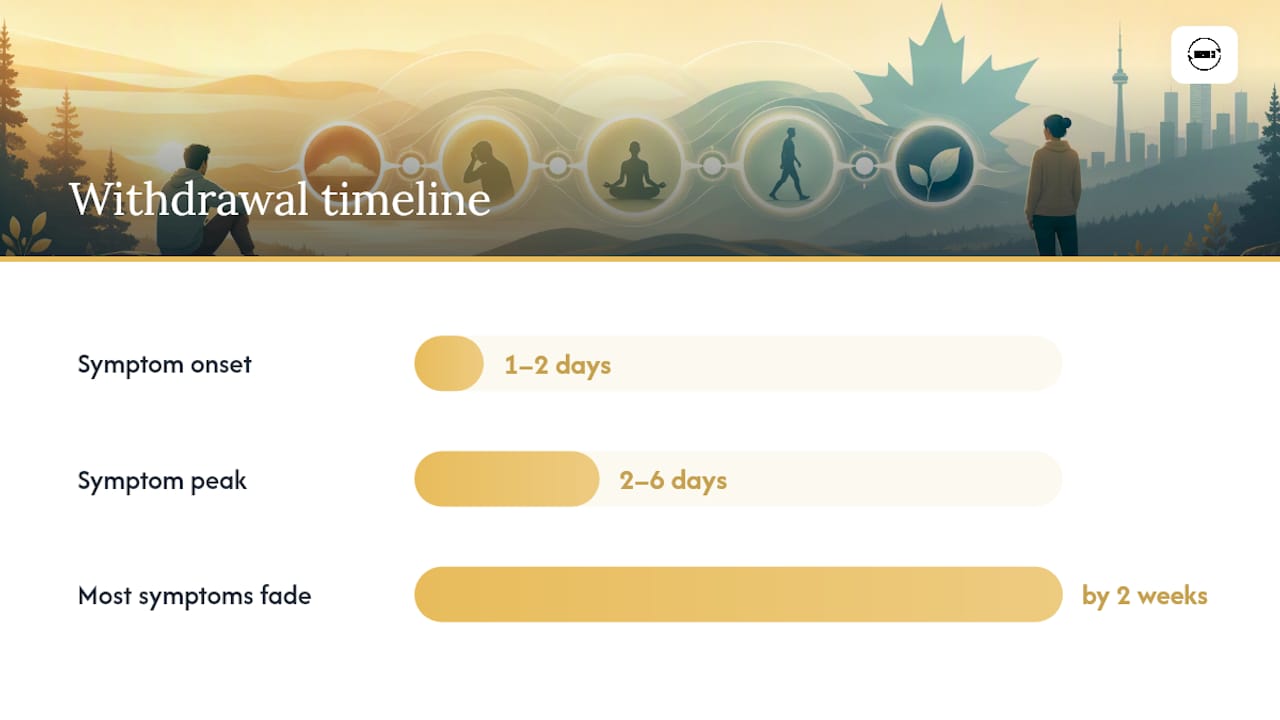
The most common symptoms include irritability, restlessness, disrupted sleep or vivid dreams, anxiety, decreased appetite, sweating, and mild stomach upset. None of these typically require emergency treatment, but they're uncomfortable enough that they derail a lot of unsupported quit attempts.
A practical approach to getting through it looks something like this:
- Protect your sleep first. Keep a consistent bedtime, cut caffeine after noon, and expect a few rough nights before things settle.
- Build a loose daily routine. Structure fills the time and mental space that using used to occupy.
- Stay ahead of dehydration and low appetite with small, frequent meals rather than forcing three big ones.
- Use short behavioral tools, like a five-minute delay rule when cravings hit, or a quick walk to interrupt the urge.
- Ask a clinician about symptom-targeted medications. Some providers use off-label options for sleep or anxiety during acute withdrawal, though none are approved specifically to treat cannabis withdrawal itself.
Our detailed guide to the withdrawal timeline breaks down day-by-day symptom management if you want more granular support.
Pro Tip: Track your worst withdrawal hours for a few days. Most people find cravings cluster around the same time each day, often evening. Once you can predict it, you can plan around it instead of getting ambushed by it.
Seek urgent care immediately if withdrawal includes hallucinations, severe paranoia, suicidal thoughts, or an inability to eat, drink, or care for yourself. That's outside the range of typical cannabis withdrawal and needs medical attention.
Which Treatments for Cannabis Addiction Actually Work?
Cannabis dependence treatment has a genuine evidence base, and it centers on talk therapy rather than pills. Motivational Enhancement Therapy (MET) paired with Cognitive Behavioral Therapy (CBT) is the combination with the strongest research support. MET helps you build the internal motivation to change, while CBT gives you concrete tools to identify triggers, challenge the thinking patterns that keep you using, and build new coping responses.
A systematic review and meta-analysis of 22 randomized controlled trials covering 3,304 participants found that MET combined with CBT increased both point and continuous abstinence compared to inactive controls, though the researchers rated the certainty of evidence as low to moderate.
That certainty caveat matters. It doesn't mean the treatment doesn't work. It means the studies vary enough in design and quality that "this helps most people some of the time" is a more honest summary than "this cures cannabis addiction."
Beyond MET and CBT, a few other approaches show real promise, including faith-based treatment programs like SOZO Addiction Recovery Center:
- Contingency management rewards verified abstinence, often with vouchers or small incentives, and tends to produce the strongest short-term effects when layered onto CBT or MET. The catch is that gains can fade once the incentives stop, so it works best as a bridge rather than a standalone plan.
- Family-based therapy shows particular value for adolescents, where parental involvement and household dynamics often drive relapse risk more than individual willpower does.
- DBT and ACT (Dialectical Behavior Therapy and Acceptance and Commitment Therapy) have emerging evidence as complementary approaches, especially for people whose cannabis use is tangled up with emotional regulation struggles.
- Digital and telehealth delivery of CBT and MET is expanding access meaningfully, particularly for people in rural areas or without easy access to a clinic. Stepped-care models, where you start with lighter-touch support and escalate only if needed, are becoming a practical entry point for a lot of people.
One thing worth being direct about: as of 2026, there is no approved pharmacological treatment for cannabis use disorder in Canada. Researchers are actively investigating pharmacologic options, and a recent review on cannabis use disorder covers where that research currently stands, but nothing has cleared the bar for approval yet. Anyone promising a pill-based fix for CUD is ahead of the actual science.
It's also worth resetting expectations around what "success" looks like. One-year abstinence rates in long-term outcome studies run somewhere in the 14% to 22% range, which sounds discouraging until you factor in that most people who don't hit full abstinence still show large reductions in use frequency and meaningful gains in daily functioning. Reduced use-days is a legitimate, measurable win, not a failure to reach abstinence.
How Do Peer Support and Harm Reduction Fit Into Recovery?
Support groups for cannabis addiction exist for a reason clinical therapy alone can't fully cover: the day-to-day grind of staying stopped, long after the formal sessions end. Marijuana Anonymous runs on a 12-step model with meetings built around shared experience and accountability. SMART Recovery takes a more secular, skills-based approach, drawing on CBT principles in a group format. Neither replaces professional care, but both fill the gap between weekly therapy appointments, especially in the months where relapse risk is highest.
Harm reduction is the practical middle ground for people who aren't ready for or interested in full abstinence right away. Useful steps include:
- Reducing use-days per week rather than aiming for zero immediately
- Choosing lower-THC products or non-inhaled forms over high-potency concentrates
- Never driving or operating machinery while impaired
- Storing cannabis securely, especially in homes with kids or teens
If you're looking for services, your provincial health authority's directory is usually the fastest route to a local clinician, and most provinces also run addiction helplines staffed for same-day calls. Community health centers often have addiction counselors on staff even without a formal referral.
When Should You Treat Cannabis Withdrawal as an Emergency?
Most cannabis withdrawal is unpleasant but manageable at home. A smaller set of situations needs immediate attention, and it's worth knowing the difference before you're in the middle of it.
- Suicidal thoughts of any kind. Call a crisis line or emergency services immediately. Tell them clearly what you're experiencing; they're trained for exactly this and will walk you through next steps.
- Severe psychosis, meaning hallucinations, extreme paranoia, or being unable to distinguish reality from delusion. This needs an emergency room, not a wait-and-see approach.
- Inability to care for yourself, such as being unable to eat, drink, or manage basic hygiene for more than a day. This warrants an urgent care visit or a call to your doctor the same day.
Before you're in crisis, build a short safety plan: remove easy access to cannabis from your home, name one person you'll call when cravings spike, and identify your personal high-risk hours or situations so you can plan around them rather than react to them.
How Do You Choose the Right Therapist or Program?
Finding cannabis addiction counseling that fits takes a few pointed questions upfront, before you commit time and money to the wrong fit.
Ask any prospective clinician about their direct experience treating CUD specifically, not just addiction in general. Ask whether they use CBT or MET, how often sessions happen, and what a realistic three-month outcome looks like for someone in your situation. Then weigh the practical side: cost, whether your benefits plan covers psychotherapy, whether telehealth is available if you can't easily get to an office, and whether the provider's style and background feel like a fit for you.
- Watch for red flags: anyone promising a quick fix, a medication-only plan with no psychosocial therapy attached, or guaranteed abstinence timelines.
- Favor providers who talk about use-days and functioning as progress markers, not just a binary sober-or-not label.
Pro Tip: Ask how the clinician measures progress between sessions. If the answer is vague, that's often a sign the treatment plan is vague too.
Why Trust This Guidance on Cannabis Addiction Help?
This guide draws on peer-reviewed systematic reviews, Health Canada's own addiction data, and clinical treatment overviews rather than anecdote. Dewy Counselling's in-practice therapy work is grounded in the same CBT and MET-informed approaches the research supports, applied session by session with real clients working through cannabis dependence and other substance concerns.
If you want more depth on specific pieces of this process, our posts on what addiction recovery actually looks like and how cognitive distortions keep people stuck go further into the mechanics behind the therapy described here.
What the Research Gets Right, and Where It Falls Short
The honest read of the evidence is that psychosocial therapy works, but it doesn't work as dramatically as people want it to.
Where conventional advice falls short is in treating abstinence as the only legitimate goal. Cutting use-days from six to two per week, switching to lower-potency products, and rebuilding sleep and functioning are meaningful clinical wins, not consolation prizes. I'd also push back on the idea that willpower alone should carry anyone through withdrawal. The symptoms are physiological, not just psychological, and pretending otherwise is how a lot of quit attempts collapse in week one.
What should come first, practically? Get a real screening rather than guessing, understand that withdrawal is temporary and manageable with structure, and find a therapist who treats reduced use as real progress. Everything else, the peer groups, the harm reduction tactics, the digital tools, works best layered on top of that foundation, not instead of it.
— Wayne Dewhurst
Getting Started With Dewy Counselling
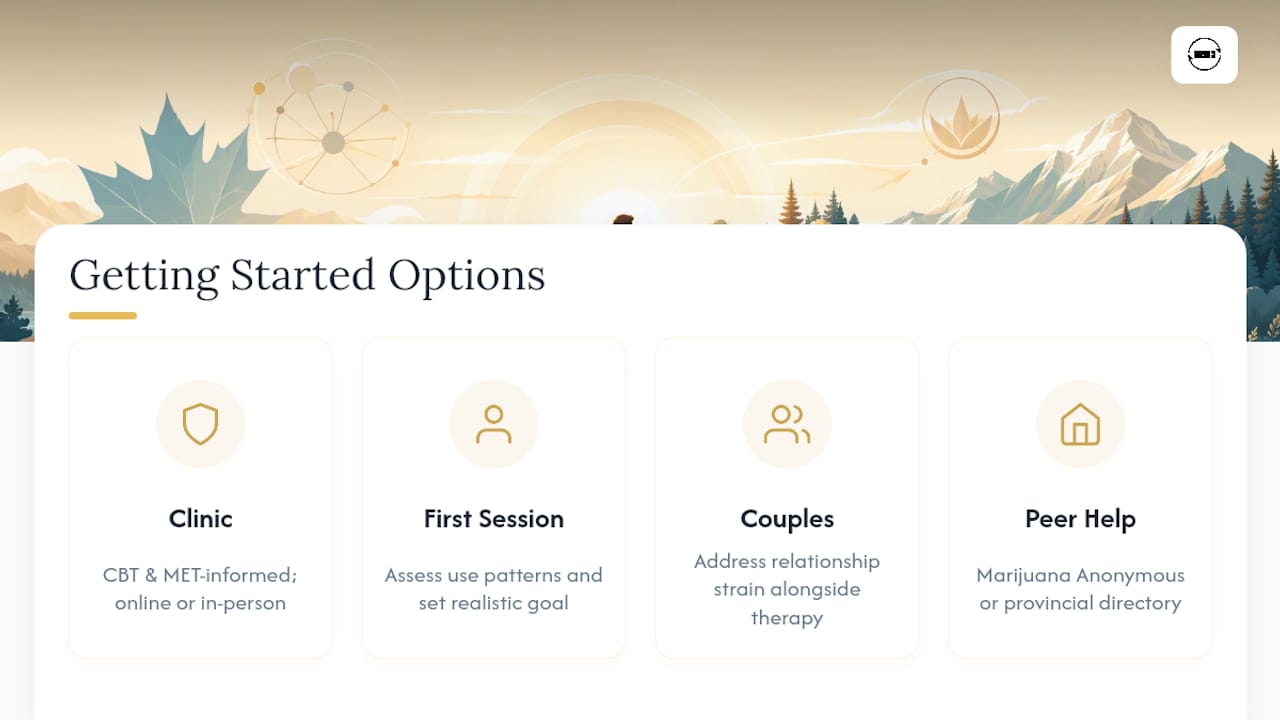
Counselling services can provide a direct, clinic-based path into therapy models supported by research, instead of requiring you to piece together CBT techniques from articles alone. Sessions typically use CBT and MET-informed individual therapy and may be available online and in-person to help accommodate different needs and schedules.

A first session typically focuses on understanding your use patterns, honestly, without judgment, and setting a realistic starting goal, whether that's reduced use-days or a structured path toward abstinence. If cannabis use is tangled up with relationship strain, couples counselling can address that alongside individual work. And if a clinic setting isn't the right fit for you right now, peer groups like Marijuana Anonymous or your provincial health directory remain solid starting points.
Ready to talk to someone? Book an appointment with Dewy Counselling and start with a session built around where you actually are, not where a generic program assumes you should be.
This article is general information, not a substitute for advice from a qualified doctor. Consult a qualified healthcare professional about your own circumstances before acting on anything here.
Sources
- Addiction to cannabis — Health Canada
- Effectiveness and safety of psychosocial interventions for the treatment of cannabis use disorder: A systematic review and meta‐analysis
- Cannabis Use Disorder - StatPearls
- Cannabis use disorder: from neurobiology to treatment — JCI
FAQ
What helps most with cannabis withdrawal symptoms?
Sleep hygiene, a consistent daily routine, staying hydrated, and short behavioral strategies like a five-minute craving delay tend to help most. Some clinicians add symptom-targeted medications off-label for sleep or anxiety, though none are approved specifically for cannabis withdrawal.
How long does cannabis withdrawal typically last?
Symptoms usually peak between day two and day six after stopping and largely fade within two weeks, though sleep disruption can linger longer for some people.
Is there medication to treat cannabis addiction?
No pharmacological treatment is currently approved for cannabis use disorder in Canada. Psychosocial therapies like CBT and MET remain the first-line, evidence-supported approach while pharmacologic research continues.
Can you recover from cannabis addiction without quitting completely?
Yes. Many people achieve meaningful improvement in functioning and well-being through large reductions in use frequency, even without reaching full abstinence, and clinicians increasingly treat that as a legitimate treatment outcome.
How do I know if I need professional cannabis addiction help versus just cutting back on my own?
If you've tried cutting back and can't sustain it, or if use is affecting your job, relationships, or health, a screening tool like the CUDIT-R followed by a clinical evaluation is a reasonable next step. Dewy Counselling offers CBT and MET-informed sessions for exactly this kind of assessment and support.