
Person centred therapy is defined as a non-directive, humanistic psychotherapy approach where the client is the expert in their own life, and the therapist creates a growth-promoting environment through three core conditions: unconditional positive regard, congruence, and empathic understanding. Developed by psychologist Carl Rogers in the 1940s and 1950s, this approach was a direct departure from the directive, therapist-led models that dominated mental health care at the time. Rogers believed every person carries an innate drive toward growth and healing, which he called the "actualizing tendency." Person centred therapy, also widely written as person centered counseling, works by removing the barriers that block that natural drive. The therapist does not diagnose, prescribe, or direct. Instead, they create the conditions where you can find your own answers.
What is person centred therapy and what are its core principles?
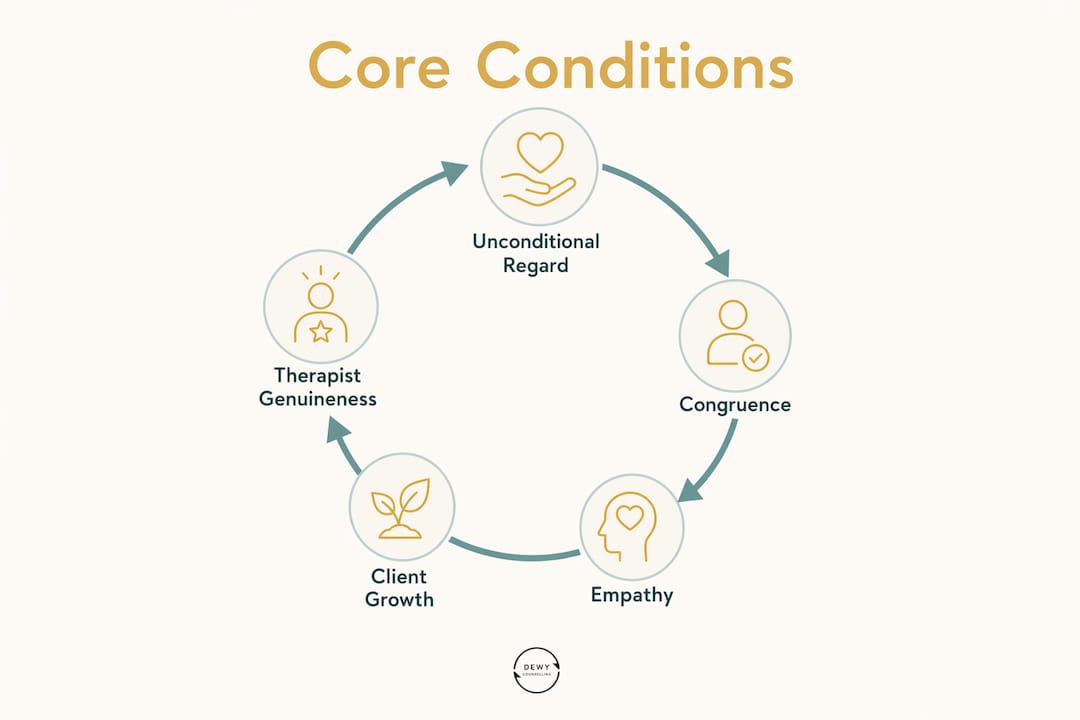
The three core conditions of person centred therapy are unconditional positive regard, congruence, and empathic understanding. These are not simply therapeutic techniques. They are the entire foundation of how the relationship between therapist and client is built.
Unconditional positive regard means the therapist accepts you completely, without judgment, regardless of what you share. There are no conditions attached to that acceptance. You do not have to present a certain version of yourself to earn the therapist's approval. This kind of acceptance is rarer than it sounds, and for many people it is the first time they have experienced it in a relationship.

Congruence refers to the therapist's genuineness. A congruent therapist is deeply involved and authentic, drawing on their own real experience to engage with you rather than hiding behind a professional mask. They may use appropriate self-disclosure when it serves the therapeutic relationship. This transparency builds trust in a way that scripted or technique-driven responses cannot.
Empathic understanding means the therapist works to accurately reflect your inner world back to you. They listen not just to your words but to the feelings underneath them. When a therapist reflects your experience accurately, you feel genuinely heard, often for the first time.
| Core condition | What it means | Why it matters |
|---|---|---|
| Unconditional positive regard | Full acceptance without judgment | Creates psychological safety for honest self-expression |
| Congruence | Therapist authenticity and transparency | Builds trust and models genuine relating |
| Empathic understanding | Accurate reflection of client's inner experience | Helps clients feel seen and understood |
Pro Tip: If you are evaluating a therapist, pay attention to how you feel after the first session. A person centred therapist will leave you feeling heard, not assessed or advised.
The therapy process has no fixed timeline. Progress is paced entirely by your comfort and readiness. That flexibility is not a design flaw. It reflects the core belief that you are the authority on your own healing.
How does person centred therapy differ from other therapeutic approaches?
Person centred therapy differs from most other therapeutic models in one fundamental way: the therapist does not hold the authority. In most directive approaches, the therapist is the expert who identifies problems, assigns meaning, and prescribes solutions. In person centred work, that power sits with you.
A clear comparison helps illustrate this. Person centred therapy contrasts sharply with psychoanalysis and CBT by avoiding therapist authority, minimizing diagnosis, and prioritizing subjective experience over symptom management. That distinction matters practically, not just philosophically.
Here is how person centred therapy differs from other common approaches:
- No diagnosis required. Person centred therapy does not require a clinical label to begin. You do not need to be "sick" to benefit. The approach treats you as a whole person, not a set of symptoms.
- No homework or structured exercises. Unlike cognitive behavioral therapy, person centred sessions do not include worksheets, thought records, or assigned tasks between sessions. The work happens in the relationship itself.
- No therapist-led agenda. Psychoanalytic therapy often follows a therapist-directed framework of interpretation. Person centred therapy follows your lead entirely. You decide what to talk about and when.
- Focus on growth, not symptom reduction. The goal is not to eliminate a specific problem but to support your broader capacity for self-awareness and authentic living.
- Emphasis on the present relationship. While psychoanalysis often focuses on past experiences and unconscious material, person centred therapy centers on the quality of the current therapeutic relationship as the primary vehicle for change.
This does not mean person centred therapy is better or worse than other approaches. It means it is built on a different set of assumptions about what people need and how change actually happens. If you want to understand differences in therapy styles more broadly, that context helps you make a more informed choice.
What are the benefits of person centred therapy for mental health?
Person centred therapy supports a wide range of personal and mental health needs, and its effectiveness is not limited to clinical diagnoses. The approach works equally well for personal growth, self-understanding, and life transitions, not only for people experiencing mental illness. That optimism about human capacity is built into the model's DNA.
The core benefits include:
- Increased self-awareness. By exploring your thoughts and feelings in a non-judgmental space, you develop a clearer picture of who you are and what you actually want.
- Stronger self-confidence. When you reach your own insights rather than receiving them from an authority figure, those insights stick. You begin to trust your own judgment.
- Authentic living. Many people spend years performing a version of themselves shaped by others' expectations. Person centred therapy creates space to reconnect with your genuine values and needs.
- Trauma recovery. Client autonomy is central to trauma-informed care, and person centred therapy restores voice and agency to people who have experienced control or being silenced. That corrective experience is often profoundly healing.
- Support through life transitions. Grief, career change, relationship breakdown, or identity shifts all respond well to a therapy that meets you where you are rather than where a protocol says you should be.
- Relationship improvement. The skills of self-awareness and authentic expression developed in therapy translate directly into healthier communication with others.
Person centred therapy also applies across settings. It works in individual sessions, couples counseling, and group therapy formats. The principles of acceptance and empathy scale naturally across these contexts.
Pro Tip: Person centred therapy is particularly well suited if you feel like you have always been told what to think or feel. The non-directive space gives you room to find your own voice, often for the first time.
What misconceptions exist about the therapist's role in person centred therapy?
The most common misconception about person centred therapy is that the therapist is passive. People expect advice, structure, and direction. When they do not receive it, they sometimes interpret the therapist's restraint as disengagement or incompetence. That interpretation misses what is actually happening.
Unconditional positive regard is a highly active and challenging process, not a passive one. Maintaining full, genuine acceptance of another person, without judgment, without agenda, and without the impulse to fix, requires enormous skill and presence. The therapist is working hard. The work is just not visible in the way that advice-giving or structured exercises are.
"The therapist's job is not to solve your problems. It is to be so fully present with you that you begin to trust your own capacity to solve them. That presence is not nothing. It is everything."
Congruence adds another layer to this. A person centred therapist does not perform neutrality. They bring their genuine self into the room, which means they may reflect discomfort, warmth, or curiosity when it serves the relationship. That authenticity is itself a therapeutic tool.
Many new clients expect homework or direct guidance, and the absence of these can feel disorienting at first. That disorientation is not a problem to fix. It is the beginning of learning to trust your own inner resources rather than outsourcing your growth to an external authority. Reviewing therapy best practices for adults can help you understand why this approach produces lasting change rather than temporary relief.
The therapist's transparency, or congruence, also corrects another myth: that the therapist is a blank screen. Person centred therapists are real people in the room with you. Their realness is part of what makes the relationship healing.
Key Takeaways
Person centred therapy works because the therapist's unconditional positive regard, congruence, and empathic understanding create the conditions where clients access their own innate capacity for growth and healing.
| Point | Details |
|---|---|
| Three core conditions | Unconditional positive regard, congruence, and empathy form the entire therapeutic foundation. |
| Client as expert | You set the pace, the agenda, and the direction of therapy with no fixed timeline. |
| Not passive therapy | The therapist's full presence and acceptance is an active, skilled process, not disengagement. |
| Broad applications | Person centred therapy supports anxiety, trauma, life transitions, and personal growth, not only clinical diagnoses. |
| Lasting self-trust | By reaching your own insights, you build confidence in your judgment that outlasts the therapy itself. |
What I have learned from watching clients lead their own healing
Wayne Dewhurst
The moment I find most striking in person centred work is not a breakthrough insight or a dramatic emotional release. It is the quieter moment when a client stops looking at me for the answer and starts looking inward. That shift, from external validation to internal authority, is what this therapy is actually about.
New clients often arrive expecting me to tell them what is wrong and how to fix it. When I do not, there is sometimes frustration. I understand it. We are conditioned to see expertise as advice-giving. But I have watched people make changes through person centred therapy that no amount of direct guidance produced in previous attempts. The difference is ownership. When you find the answer yourself, you believe it.
The hardest part of this work, honestly, is maintaining unconditional positive regard when a client shares something that challenges my own values or reactions. That is where congruence and self-awareness as a therapist become non-negotiable. You cannot offer genuine acceptance while privately judging. Clients feel the difference, even when they cannot name it.
If you are considering this approach, expect it to feel unfamiliar at first. Sit with that. The discomfort of not being directed is often the first sign that something real is beginning.
— Wayne Dewhurst
Person centred counseling at Dewycounselling
Dewycounselling offers individual, couples, and family therapy grounded in person centred principles. Whether you are working through anxiety, a life transition, or relationship challenges, the therapists at Dewycounselling bring genuine presence, empathy, and unconditional positive regard to every session.

Sessions are available both online and in person, making professional support accessible wherever you are. If you are ready to work with a therapist who follows your lead rather than prescribing a path, explore psychotherapy services at Dewycounselling and take the first step toward growth that is genuinely yours.
FAQ
What is the main goal of person centred therapy?
The main goal is to create conditions where clients access their own innate capacity for growth. The therapist does not set the goal. The client does.
Is person centred therapy effective for anxiety and depression?
Person centred therapy is effective for anxiety, depression, trauma, and life transitions. Its strength lies in building self-awareness and self-trust, which address the root of many mental health struggles rather than just the symptoms.
How long does person centred therapy take?
There is no fixed timeline. Therapy duration depends entirely on client comfort and readiness, which is itself a core feature of the approach rather than a limitation.
Who is person centred therapy best suited for?
Person centred therapy suits anyone seeking personal growth, self-understanding, or support through life changes. It assumes individuals are resourceful and capable, not broken, making it accessible to people who do not carry a clinical diagnosis.
Does the therapist give advice in person centred therapy?
The therapist does not give advice. Active empathic listening and full presence replace direct guidance, helping you develop trust in your own judgment rather than dependence on an external authority.