
Combination treatment, psychotherapy paired with medication, is generally the most effective path for persistent depressive disorder, and it works better than either approach alone. The immediate next step is contacting a licensed therapist or your primary care provider to start an evaluation. Expect early relief to take several weeks, with meaningful change unfolding over months, not days, and regular follow-up along the way.
TL;DR:
- Combining psychotherapy and medication offers the strongest chance of improvement, with therapy often lasting longer than typical for episodic depression.
- Long-term treatment plans should involve sustained therapy over several months and realistic expectations for gradual progress.
- Response is usually seen in four to six weeks of medication, but psychotherapy may require ongoing months of consistent sessions for meaningful change.
- If symptoms worsen, particularly with thoughts of suicide or severe functional decline, immediate escalation to specialist or emergency care is necessary.
- Supportive lifestyle habits like regular sleep, exercise, and social contact can reinforce clinical treatment but are not substitutes for professional care.
What Dysthymia Treatment Actually Involves
Persistent depressive disorder, the clinical term for what's commonly called dysthymia, is a low-grade but long-lasting depression that lingers for two years or more. It doesn't announce itself the way a major depressive episode does. Instead, it settles in quietly, coloring how someone experiences work, relationships, and daily motivation, often for so long that the person assumes this flatness is just their personality.
Treatment goals center on two things: reducing symptom severity and restoring day-to-day functioning. That second piece matters as much as the first. Someone can report feeling "a little better" on a mood scale while still struggling to get out of bed, keep up with friends, or perform at work. A sound treatment plan tracks both.
Care for persistent depressive disorder draws from three connected domains:
- Psychotherapy — structured talk therapy that targets thought patterns, relationship dynamics, or unresolved emotional material driving the low mood.
- Medication — antidepressants that adjust brain chemistry involved in mood regulation, typically SSRIs, SNRIs, or occasionally TCAs.
- Self-management and support — sleep, exercise, social connection, and relapse-prevention habits that reinforce clinical treatment rather than replace it.
A clinician typically builds a plan by weighing symptom severity, prior treatment history, and personal preference. Someone with mild symptoms and a strong support network might start with therapy alone. Someone with more entrenched symptoms, or a history of prior episodes, often does better starting both therapy and medication at once. The StatPearls clinical review on persistent depressive disorder treats combination care as the standard recommendation precisely because chronic depression resists quick fixes better than acute episodes do.
Which Psychotherapy Approach Fits Your Situation?
Not all talk therapy targets the same problem, and picking the wrong model can waste months. The therapies with the strongest track record for persistent depressive disorder are cognitive behavioral therapy (CBT), interpersonal therapy (IPT), psychodynamic therapy, and mindfulness-based cognitive therapy (MBCT), according to the Medscape clinical treatment overview.
CBT treats depression as a pattern of distorted thinking that reinforces itself over time: "I always fail" becomes a lens that filters out contrary evidence. Sessions are structured and often include homework, like tracking automatic negative thoughts between appointments. It suits people who want a concrete, skills-based approach and can tolerate some self-monitoring.
IPT looks at depression through the lens of relationships and role transitions, grief, conflict, or life changes that have destabilized someone's sense of connection. If your low mood traces clearly to a strained marriage, a job loss, or an unresolved family rupture, IPT often gets more traction than a purely cognitive approach. Our breakdown of interpersonal therapy for depression covers how sessions typically unfold.
Psychodynamic therapy digs into earlier patterns, often formed in childhood, that keep replaying in adult relationships and self-talk. It moves slower than CBT and suits people drawn to understanding why they feel stuck, not just interrupting the feeling itself.
MBCT blends meditation practice with cognitive therapy techniques, teaching people to notice a negative thought spiral before it takes hold rather than trying to argue their way out of it once it does. It's especially useful for relapse prevention after an initial course of treatment. Our guide to mindfulness-based depression treatment explains how it differs from standard CBT.
For chronic cases tied to early trauma, some clinicians consider the cognitive behavioral analysis system of psychotherapy (CBASP), a model built specifically for long-standing depressive patterns. Evidence on CBASP is mixed, and it tends to come up only when standard CBT hasn't moved the needle.
Because dysthymia is chronic by definition, a short course rarely does the job. Research on treatment duration finds that longer psychotherapy courses and a higher total number of sessions produce better outcomes for chronic depression than the brief, symptom-focused courses often used for single depressive episodes. If a therapist proposes six sessions and calls it done, that's a mismatch for a condition that's been building for years.
Choosing a therapist is a practical decision, not just a rapport check. Before your first session, consider:
- Ask what treatment model they use and why it fits chronic, low-grade depression specifically.
- Ask how they'll measure progress, whether through standardized tools like the PHQ-9 or informal check-ins.
- Ask how many sessions they typically recommend for persistent depressive disorder before reassessing.
- Ask whether they coordinate with a prescriber if medication becomes part of the plan.
Pro Tip: Bring a written timeline of your symptoms to your first appointment, when the low mood started, what's changed, what's stayed the same. Therapists diagnose persistent depressive disorder partly by duration, and a clear timeline saves weeks of piecing that history together in session.
Medication Options: Timelines, Side Effects, and What to Expect
Medication for persistent depressive disorder usually starts with an SSRI (selective serotonin reuptake inhibitor) or SNRI (serotonin-norepinephrine reuptake inhibitor), the two classes with the most favorable side-effect profiles for long-term use. Older tricyclic antidepressants (TCAs) still show up in treatment plans, typically when someone hasn't responded to first-line options, since TCAs tend to carry a heavier side-effect burden. Bupropion and mirtazapine are common alternatives when sexual side effects or sleep disruption from an SSRI become a problem, each working through a different mechanism than the standard serotonin-focused drugs.
A prescriber's choice often comes down to your specific symptom pattern. Someone with low energy and poor concentration might do better on bupropion, which tends to be more activating. Someone with significant sleep disruption might respond well to mirtazapine, which is more sedating at lower doses. This is genuinely individualized, and it's common to try more than one medication before finding the right fit.
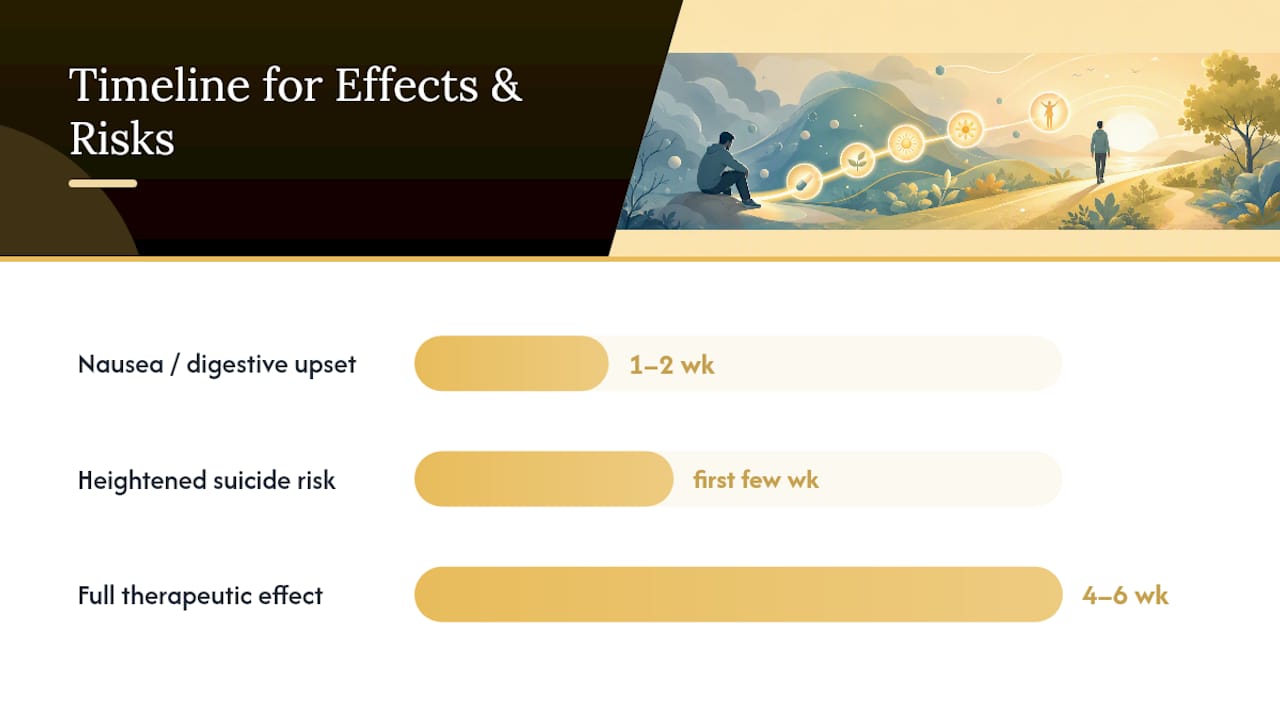
Here's the part patients underestimate most: antidepressants don't work overnight. Full therapeutic effect commonly takes 4 to 6 weeks, sometimes longer, and doses often need adjusting during that window. A Mayo Clinic review of diagnosis and treatment notes that patients frequently stop a medication too early, mistaking the slow ramp-up for a failed trial. Give a medication its full window before deciding it isn't working, and only stop under medical guidance.
Common side effects worth watching for early on include:
- Nausea or digestive upset in the first one to two weeks, usually with SSRIs and SNRIs.
- Sleep changes, either insomnia or drowsiness, depending on the drug class.
- Sexual side effects, more common with SSRIs than bupropion or mirtazapine.
- Weight changes, particularly with mirtazapine and some longer-term SSRI use.
- Dry mouth, constipation, or dizziness, more pronounced with TCAs.
One monitoring point matters more than any other. Any new or worsening thoughts of suicide, especially in the first few weeks of a new medication or dose change, need immediate contact with your prescriber or a crisis line. This warning applies across age groups but is emphasized most strongly for younger patients starting antidepressant therapy. It's a real, if uncommon, risk that both patients and prescribers need to track closely rather than assume away.
Some older agents studied in earlier meta-analyses aren't approved or available in every country, so don't assume a drug you've read about online is an option here. The StatPearls review flags this directly: verify availability with your prescriber rather than requesting a specific medication by name from an outdated source.
Does Combining Therapy and Medication Really Work Better?
Yes, and the evidence isn't subtle. Persistent depressive disorder responds better to combined treatment than to therapy or medication alone in the clinical literature, largely because chronic depression tends to have multiple reinforcing causes, biological, cognitive, and relational, that a single intervention rarely addresses all at once.
Combination therapy for persistent depressive disorder consistently shows superior outcomes in clinical practice compared with either psychotherapy or medication used in isolation, with higher response rates and better functional improvement.
That's the core finding from the StatPearls clinical reference, and it lines up with what Harvard Health's overview of dysthymia recommends for patients navigating a first treatment plan: medication to stabilize mood biology, therapy to rebuild the thinking and behavior patterns that chronic depression entrenches over years.
The combination effect isn't universal or automatic. The research behind it draws from studies that vary in session count, medication type, and follow-up length, so "combination therapy works better" is a strong general pattern, not a guarantee for every individual case. Some people respond fully to therapy alone. Others need medication first just to have enough energy and concentration to engage meaningfully in sessions.
In practice, this often looks like a prescriber starting an SSRI while a patient begins CBT or IPT sessions in parallel, with both providers checking in every few weeks. The medication takes the edge off physiological symptoms, sleep, appetite, energy, while therapy does the slower work of unlearning the negative self-beliefs that chronic depression tends to calcify over time. Neither piece replaces the other; they're solving different parts of the same problem.
How Long Does Treatment Take to Show Results?
Medication and therapy run on different clocks, and confusing the two leads to premature discouragement. Antidepressants typically show partial effects within two to four weeks and full effect by four to six weeks. Psychotherapy for chronic depression runs longer, often months, because it's working against thought and relationship patterns that have had years to solidify.
Clinicians generally track progress in three categories:
- Response means a meaningful drop in symptom severity, often defined as at least a 50 percent reduction on a standardized measure like the PHQ-9.
- Partial response means some improvement, but symptoms and functional impairment persist enough to warrant adjusting the plan.
- Nonresponse means little to no change after an adequate trial, which usually prompts a medication switch, an added therapy component, or a specialist referral.
Because persistent depressive disorder is chronic almost by definition, longer courses of therapy with more total sessions tend to outperform the brief, symptom-focused courses designed for single depressive episodes. A six-session CBT course built for situational depression usually isn't enough here.
Once symptoms stabilize, the work shifts to maintenance: staying on medication for a clinician-recommended period, even after feeling better, and scheduling occasional booster therapy sessions to reinforce coping skills. Relapse-prevention planning, identifying early warning signs and having a response plan ready, matters more for chronic depression than for a single depressive episode, since the pattern has already proven it can persist for years.
Self-Care Steps That Support Clinical Treatment
Lifestyle habits don't replace therapy or medication, but they meaningfully affect how well both work. Sleep, exercise, and social connection influence the same mood-regulation systems that antidepressants and talk therapy target, which is why clinicians treat self-care as a genuine part of the plan rather than an afterthought.
Practical measures worth building into daily life:
- Keep a consistent sleep and wake schedule, since irregular sleep worsens mood regulation and can blunt medication response.
- Add regular movement, even brief daily walks measurably improve depressive symptoms over time.
- Limit alcohol and recreational drug use, both of which interfere with antidepressant effectiveness and worsen mood stability.
- Schedule small pleasant activities deliberately; depression tends to erase the impulse to do enjoyable things, so it has to be scheduled rather than waited for.
- Maintain social contact, even low-effort contact, since isolation reinforces the negative thinking patterns therapy is trying to unwind.
The MedlinePlus overview of persistent depressive disorder lists these same measures as supportive, not curative, additions to clinical care. If someone you love is managing chronic depression, our guide on supporting a partner through depression covers how to help without overstepping.
Pro Tip: If you're struggling to start even one of these habits, pick the smallest possible version. "Walk to the mailbox" beats "start exercising" because it's actually achievable on a bad day, and small wins compound.
One point deserves direct, unambiguous language: if you're having thoughts of suicide or self-harm, that is not a self-care problem. Contact a crisis line, go to an emergency room, or call 911 immediately. Self-care habits support recovery over weeks and months; they are not a response to acute risk.
When to Escalate Beyond Standard Treatment
Certain signs mean it's time to move faster than a routine follow-up schedule allows:
- Suicidal thoughts, plans, or increasing hopelessness, at any point in treatment.
- Severe decline in ability to work, maintain relationships, or manage basic daily tasks.
- Medication side effects that are intolerable or worsening rather than improving.
- No meaningful change after an adequate trial of both therapy and medication.
When standard treatment stalls, a psychiatric referral for medication optimization is often the first step, since psychiatrists typically manage more complex medication combinations than a general practitioner. In cases of treatment-resistant persistent depressive disorder, options like electroconvulsive therapy (ECT) or newer neuromodulation techniques exist, but these are reserved for cases where standard treatment has genuinely failed, not a first-line recommendation. Before a referral, gather a written history: what you've tried, for how long, at what doses, and what changed. That single document saves specialists weeks of reconstruction work.
How Dewy Counselling Approaches Persistent Depressive Disorder
A psychotherapist may work with individuals managing depression, anxiety, and the relational strain chronic mood symptoms often create. Individual psychotherapy is often offered in both online and in-person formats, which matters for persistent depressive disorder specifically, since consistent, longer-term engagement is easier to sustain when session logistics aren't a barrier.
For someone weighing the treatment paths covered above, Dewycounselling's individual sessions can incorporate CBT-style thought work, interpersonal-focused approaches, or mindfulness-based techniques depending on what's driving the symptoms. A first appointment typically involves reviewing symptom history and duration, similar to what's outlined earlier in this guide, to shape a realistic, individualized plan from the start.
What Actually Matters Most in Long-Term Treatment
Most advice on chronic depression treats it like acute depression with a longer timeline attached. That's the wrong frame. The research on session count and treatment duration makes a stronger claim: persistent depressive disorder often needs a fundamentally different treatment dose, not just more patience with the same six-to-eight-session model built for situational episodes.
The conventional advice also underweights how often people quit medication right as it starts working. The four-to-six-week window isn't a formality; it's the actual mechanism of these drugs, and stopping at week three because "nothing's changed" is one of the most common, and most avoidable, reasons treatment fails.
If you take one thing from this guide, prioritize duration over speed. Ask any therapist or prescriber directly how long they expect treatment to run for a chronic condition, not a typical case. A vague answer is itself useful information. The people who do best with persistent depressive disorder tend to be the ones who treat recovery as a months-long process with measurable checkpoints, not a switch that flips once they find the "right" therapist or pill.
— Wayne Dewhurst
Ready to Start Treatment? Here's What to Expect
If chronic low mood has been running in the background of your life for years, the options above aren't theoretical. Individual psychotherapy sessions, available online or in person, built around the same evidence-based approaches discussed throughout this guide, may be a direct next step, without a long waitlist standing between you and your first appointment.

An initial session focuses on understanding your symptom history and what's already been tried, then shaping a plan around real treatment timelines rather than vague reassurance. If medication is part of your picture, sessions can run alongside a prescriber's care rather than in place of it. You can review Dewycounselling's psychotherapy services to see session formats, or go directly to book an appointment and get a date on the calendar this week instead of next month.
Sources
For readers who want the underlying clinical detail behind this guide, these sources provide deeper background:
- Persistent Depressive Disorder - StatPearls - NCBI Bookshelf
- Medscape: Treatment of dysthymia / PDD
- Journal article: pharmacological treatment notes (2024)
- MedlinePlus: Persistent depressive disorder
None of these replace an individualized evaluation. Use them to prepare informed questions for your own therapist or prescriber, not as a substitute for their guidance.
This article is general information, not a substitute for advice from a qualified doctor. Consult a qualified healthcare professional about your own circumstances before acting on anything here.
FAQ
What is the most effective treatment for dysthymia?
Combined psychotherapy and medication generally produces the best outcomes for persistent depressive disorder, outperforming either approach used alone in most clinical evidence.
How do you treat dysthymia when it hasn't responded to standard therapy?
Nonresponse usually prompts a medication switch, the addition of a different therapy model, or a psychiatric referral for closer monitoring and dose adjustment; treatment-resistant cases occasionally involve options like ECT.
Is dysthymia hereditary?
Family history increases the likelihood of developing persistent depressive disorder, though genetics interact with life stress and environment rather than acting as a sole cause.
What are the two main types of dysthymia?
Clinicians generally distinguish between pure dysthymic syndrome, chronic low-grade depression without a major depressive episode, and "double depression," where a major depressive episode occurs on top of existing persistent depressive symptoms.
How long does dysthymia treatment take to work?
Medication typically shows full effect within four to six weeks, while psychotherapy for chronic depression often takes several months of consistent sessions to produce lasting change.