Driving anxiety is a real and common fear, and it responds well to treatment. The most effective approach combines gradual, planned exposure to driving with cognitive behavioural therapy (CBT), which teaches you to question the thoughts that make the road feel more dangerous than it is. You can start on your own with small steps, and if the fear is shrinking your life, a therapist can build the plan with you. At Dewycounselling we offer psychotherapy for anxiety in person at two locations and online, so you can begin from wherever you feel safe.
TL;DR
- Feeling tense behind the wheel is normal. It becomes a problem when the fear is persistent, severe, and makes you avoid driving, routes or trips you need.
- Avoidance and "safety behaviours" feel helpful but keep the fear alive. Gradual exposure is how the fear loosens.
- CBT with graded exposure is the best-supported treatment for specific fears like driving. It is typically delivered over about 12 to 15 weekly sessions.
- If you cannot concentrate or are panicking, do not drive that trip. Rest, then try again with a smaller step.
- If the fear follows a collision, or affects work and relationships, talk to a therapist. Sessions with us are $175 per hour, in person or online.
Is driving anxiety normal?
Yes. CAMH, Canada's largest mental health teaching hospital, notes that everyone experiences anxiety symptoms, and that they are generally occasional and short-lived. Anxiety is the body's fight-or-flight response: your brain releases adrenaline, and you feel nervous, tense, dizzy, sweaty, shaky or breathless. These sensations are unpleasant, but they are not harmful and they pass.
Driving is a setting where this alarm goes off easily. You are moving fast, responsible for other people, and unable to simply leave. A new driver in Toronto traffic, a parent after a near miss on the 401, or someone returning to the road after years away can all feel that surge.
The line between ordinary nerves and an anxiety problem is not about how bad one drive felt. CAMH says anxiety goes beyond the normal range when symptoms are persistent and severe and get in the way of work, socializing or daily tasks. Whether it deserves professional attention depends on the distress it causes, its effect on your life, and the context in which it happens.
It is also widespread. The Canadian Psychological Association's clinical practice guidelines for anxiety report that about 18% of people experience an anxiety disorder in a given year, and about 8.7% a specific phobia, an intense fear of a particular situation, with driving given as one example. If fear of driving is keeping you home, you are far from alone.
Driving anxiety symptoms to recognize
Anxiety shows up in three ways, and CAMH describes all of them: in the body, in thoughts, and in behaviour.
In the body. Racing heart, shortness of breath, trembling, sweating, dizziness, tight chest or hands, and a sense of being unreal or foggy. These are out of proportion to what is actually happening on the road.
In your thoughts. "I'm going to lose control." "Everyone is watching me." "If I panic on the highway I won't be able to stop." You may replay a past accident or imagine a new one. Concentration can narrow, and this is the origin of the "brain fog" many people describe: when the alarm system takes over, there is less attention left for the task.
In what you do. This is the part people miss. CAMH lists avoiding feared situations, such as driving, but also subtler avoidance and safety behaviours, like always carrying a phone in case you need to call for help. In driving, this can look like:
- Refusing highways, bridges, left turns or night driving
- Only driving routes you know perfectly, or only with a passenger
- Leaving early to avoid rush hour, or turning down invitations that need a car
- Gripping the wheel, staying in the right lane, or driving far below the speed of traffic
Each of these brings short-term relief. The trouble is what they teach your brain: that the drive was dangerous and you were saved by the workaround. The fear then grows, and your world gets smaller.
What causes fear of driving, and what keeps it going
There is rarely one cause. CAMH explains that anxiety problems appear to arise from a combination of psychological, biological and social factors, including stressful or traumatic life events, family history, and other medical or psychiatric problems.
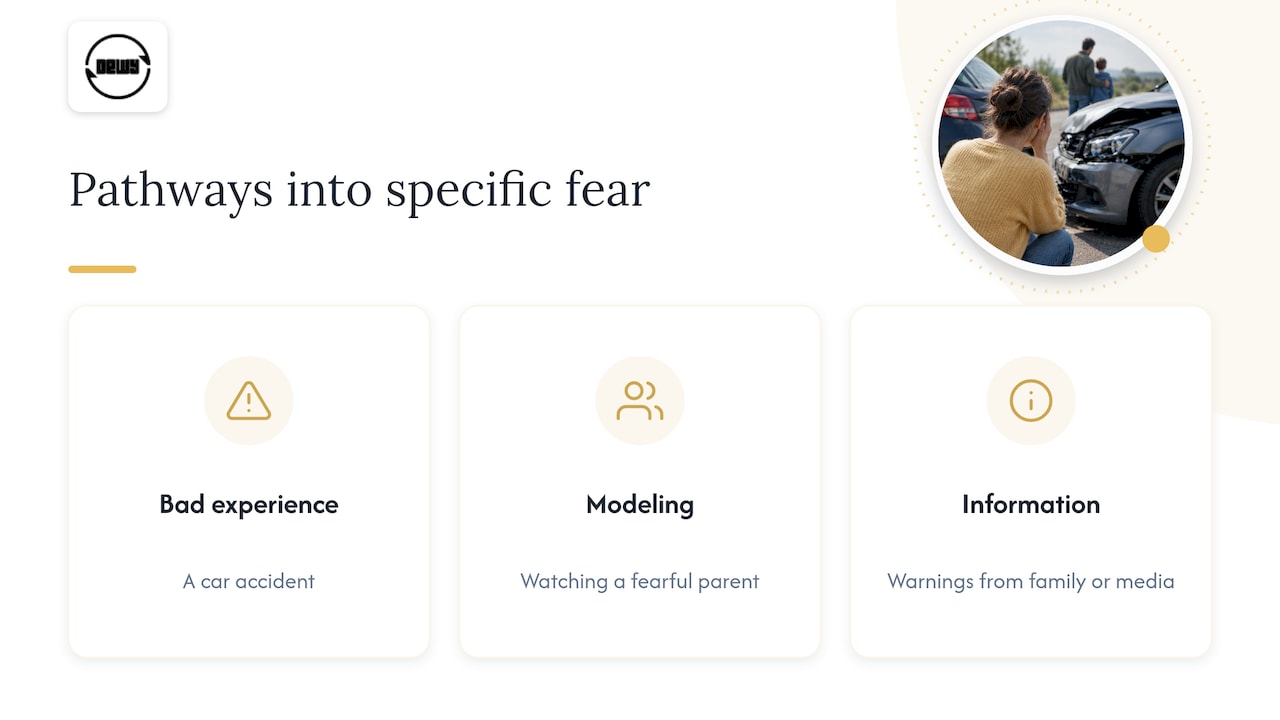
Martin Antony, a University of Toronto psychologist who studies phobias, describes three common pathways into a specific fear: a direct bad experience (such as a car accident), modeling (watching a fearful parent), and information (warnings from family or the media). These pathways do not affect everyone equally, which is why two people can survive the same crash and only one develops a fear of driving.
After a collision
St. Joseph's Health Centre in London, Ontario, notes that people who have been in severe motor vehicle accidents can develop anxiety about driving or being a passenger. It lists fear of being in a car, difficulty concentrating, insomnia, nervousness and persistent thoughts about the accident as common factors that affect safe driving, and says screening for post-traumatic stress disorder (PTSD) may be recommended when anxiety is severe. If your fear began with a crash and you have nightmares, flashbacks or constant dread, mention it to your family doctor and to a therapist. Trauma-related fear is common and treatable.
Why it persists
The engine of most driving fear is avoidance. Every time you skip the highway, the alarm learns it was right. Reassurance-seeking ("Are you sure it's safe?") and overpreparing work the same way. The fear is not a character flaw. It is a learned pattern, and patterns can be unlearned.

How to overcome driving anxiety, step by step
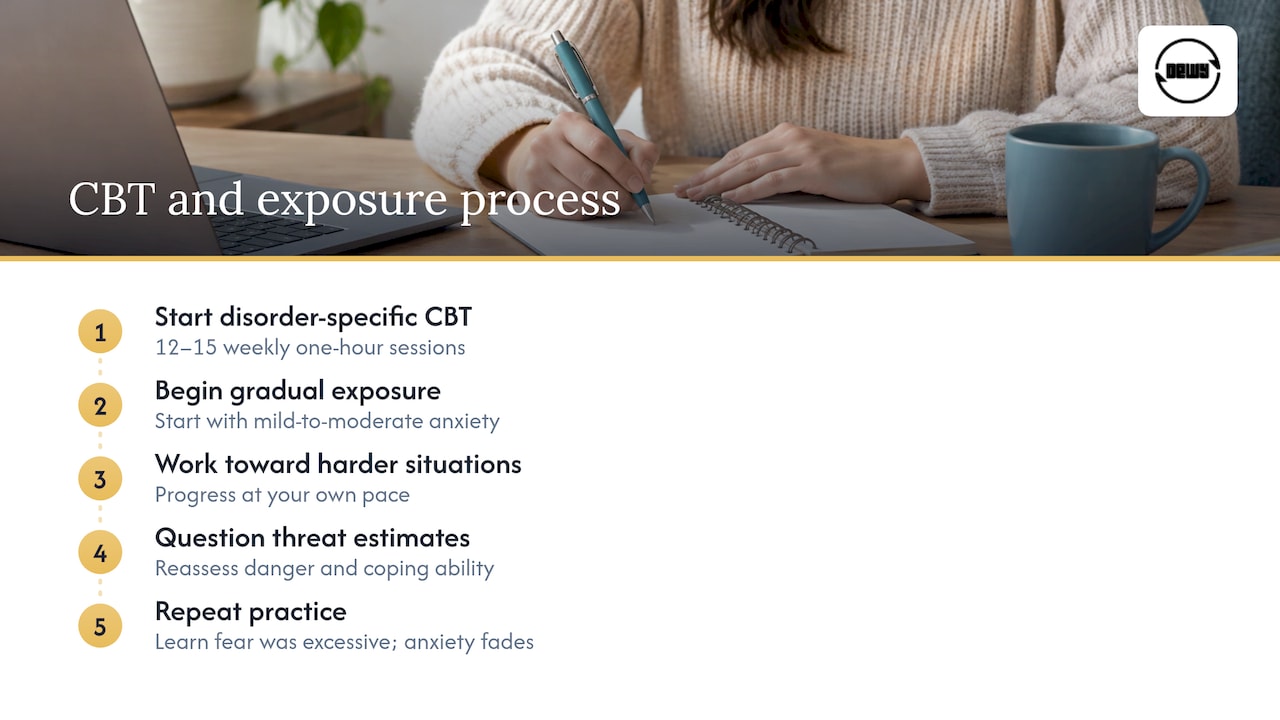
CAMH describes the most effective treatment for anxiety problems as disorder-specific CBT, typically 12 to 15 weekly one-hour sessions, with gradual exposure as a standard component. Exposure starts with situations that cause mild to moderate anxiety and works toward harder ones. Alongside it, you learn to identify and question the habit of overestimating danger and underestimating your ability to cope. Through repeated practice, your body learns that the fear was excessive, and the anxiety fades. Antony likewise notes that exposure done gradually, at your own pace, is the most effective treatment for specific phobias.
Here is how that looks for driving. If you want a deeper look at the method itself, our guide to cognitive behavioural therapy explains how it works. For an overview of what evidence-backed anxiety care involves, this page on evidence-backed anxiety therapy options covers CBT and exposure.
Step 1: Check you are fit to drive that day
Exposure should be challenging, not unsafe. The ICBC Learn to Drive Smart manual states that when you are very anxious, angry or upset, you miss important information and your thinking becomes unclear. It advises taking a couple of moments to calm down, and if you cannot focus, not driving: take the bus or ask a friend. The Canadian standard on driver fitness (CCMTA's NSC-6) adds that choosing not to drive when you are unwell is a sign of good judgement and self-awareness. Skipping a drive on a bad day is not failure and is different from the avoidance that feeds anxiety: you are making a safe choice and returning to the plan the next day.
Step 2: Build a fear ladder
Write down every driving situation that worries you, then rate each from 0 to 100 for how anxious it makes you. Order them from lowest to highest. This is your "fear ladder". A typical one might run:
- Sitting in a parked car with the engine on (20)
- Riding as a passenger on a short, familiar trip (30)
- Driving around a quiet block, in daylight, on a weekend morning (40)
- Driving familiar neighbourhood streets (50)
- Driving part of an avoided route (60)
- Driving in moderate traffic or at dusk (75)
- Driving on a highway for one exit (90)
These graded steps mirror those described in Canadian clinical practice, and they are most useful when written around your own fears, not a generic list. This is where people most often go wrong: they jump to step 7 after a good day, panic, and conclude that exposure does not work. Equally common is stalling on step 3 for months because nothing feels ready. A therapist helps you pitch each step so it is hard enough to teach your brain something and manageable enough to finish.
Step 3: Practise each step until the fear drops
Stay at one rung until your anxiety falls noticeably, then repeat it a few times on different days before moving up. Expect the fear to rise first and then ease. That curve, called habituation, is the learning. Leaving the moment it peaks teaches the opposite lesson.
Step 4: Drop the safety behaviours gradually
Once a step feels manageable, take out one crutch: drive without the phone in your hand, without the passenger, without the radio blaring, or in the middle lane. This is how you learn that you were never relying on those things to stay safe.
Step 5: Challenge the predictions
Before each drive, write what you fear will happen and how likely it is. Afterward, write what actually happened. Over weeks, the gap between the two is the evidence that reshapes the fear. This is the cognitive part of CBT that CAMH describes: identifying, questioning and correcting overestimates of danger.
Step 6: Plan for a panic surge
When the body floods with adrenaline, remind yourself that the sensations are disturbing but not harmful and will pass. If you cannot concentrate, follow the ICBC advice: stop driving that trip, pull over only when it is safe to do so, and use a grounding routine before you continue. Our guide to panic attack grounding scripts gives you words to use in the moment, and our article on panic attack therapy explains what treatment involves when panic is frequent.
If you are scared to learn to drive
Fear before you have ever driven is common, and it is the same problem in a different order. The same ladder applies: start with sitting in the driver's seat, then a parking lot with an instructor you trust, then quiet streets. The Canadian Association of Occupational Therapists' practice guide on driving recognizes that some novice drivers need support to address challenge areas before they are ready, so waiting and building skills first is a legitimate choice. Therapy can help with the worry itself, so lessons become practice rather than endurance.
When to talk to a professional
Self-help steps are a fine place to begin. Consider booking a therapist when:
- You avoid driving in ways that affect work, school, childcare or social life
- The fear started after a crash, or you have flashbacks, nightmares or constant dread
- Panic attacks happen while driving or are starting to happen elsewhere
- Your anxiety has lasted months. CAMH's diagnostic guidance for professionals looks for symptoms that are excessive, cause significant distress or impairment, and typically last six months or more
- You are stuck on the same rung despite repeated attempts
The cost of staying at home is also real. The Canadian Association of Occupational Therapists notes that giving up driving can bring loneliness, social isolation, lower self-esteem and strained relationships, which is why it matters not to let fear quietly make that decision for you.
The Canadian Medical Association's driver fitness guide also states that anxiety can interfere with concentration or cause freezing at the wheel, and that people with crash-related PTSD or phobic avoidance can gain significant help through counselling. If you ever feel unable to control the vehicle, or you are not sure you are safe to drive, see your doctor.
What working with us looks like
We provide individual psychotherapy for anxiety, including panic and phobic fears, with more than 20 years of experience working with diverse clients and a range of evidence-based approaches. Sessions are available in person at two locations and online, so you can start the conversation from your own kitchen before you ever get in a car. Our standard in-person or online session is $175 per hour, a mobile session is $225 per hour, and a prepaid annual membership is $1,750 per year. We also offer sliding scale pricing.
You can read about our psychotherapy services or see the session options and prices.

Our perspective
Fear of driving is one of the most quietly limiting anxieties we hear about. People rarely come in saying they are afraid of the car. They say they stopped going to their sister's, turned down a job, or started depending on a partner for every errand.
Our view is that the fear is not a weakness and not something to white-knuckle through. It is a learned alarm, and it can be retrained with patience, a clear plan and someone alongside you. We work with individuals, couples and families, and driving fear often touches all three: a partner who now does all the driving, a teen whose parent cannot take them anywhere.
That is why we offer both in-person and online sessions, and sliding scale pricing: getting started should not be one more hurdle. With more than 20 years of experience and multiple evidence-based approaches, we aim to help you rebuild confidence one step at a time, at a pace that feels possible.
Wayne Dewhurst
FAQ
Is driving anxiety a real condition?
Yes. When fear of driving is excessive, leads to avoidance and interferes with daily life, it can be a specific phobia or part of panic disorder or PTSD. Clinical guidelines list driving as an example of a feared situation. It is common and treatable.
How long does it take to overcome fear of driving?
It varies from person to person. CAMH describes typical CBT for anxiety as 12 to 15 weekly one-hour sessions, with practice between sessions. Many people notice the fear easing as they move up their ladder, and steady practice matters more than speed.
What should I do if I feel panicky while driving?
Prioritize safety. If you cannot focus, stop driving that trip when it is safe to do so, let the sensations pass, and ask someone else to drive or take transit. ICBC advises not getting behind the wheel if you cannot focus. Then return to a smaller step next time.
Can therapy help if my fear started after an accident?
Yes. Fear after a collision is a common reaction, and counselling can help with crash-related fear and avoidance. If you have flashbacks, nightmares or severe distress, mention them to your doctor and to a therapist, since screening for PTSD may be recommended.
Do I have to drive during therapy?
Not at first. Early sessions focus on understanding your fear and building your ladder, and the first steps can be as small as sitting in a parked car. Driving practice grows from there, at your pace.
Sources
- CAMH, Anxiety Disorders: An Information Guide (2024)
- Canadian Psychological Association, Anxiety Clinical Practice Guidelines (2006)
- American Psychological Association, Understanding and overcoming phobias with Martin Antony
- St. Joseph's Health Centre London, Driving with Anxiety / PTSD
- ICBC, Learn to Drive Smart manual
- CCMTA, NSC 6 Standard: Determining Driver Fitness in Canada
- Canadian Medical Association, Driver's Guide: Psychiatric disorders
- CAMH, Anxiety: Diagnosis
- Canadian Association of Occupational Therapists, Practice Guide on Enabling Participation in Driving