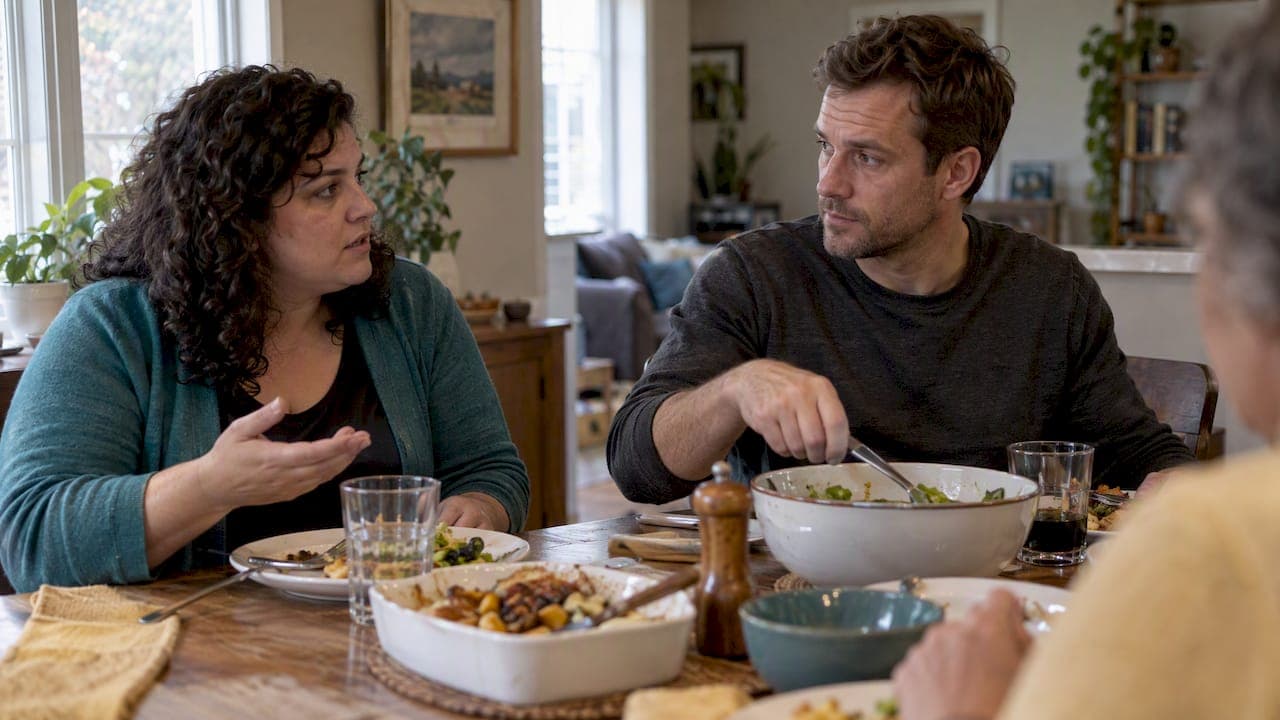
Adult sibling rivalry is not childish behaviour you should have outgrown. It is a common, understandable pattern in which old family roles, comparison and unmet needs for fairness resurface in grown-up settings: an estate, a parent's care, a holiday, a family group chat. It can be softened, and many adults do it without ever becoming best friends. This article explains why the rivalry persists, how to tell rivalry from conflict from harm, and what you can realistically work toward, on your own or with a therapist.
TL;DR
- Rivalry, warmth and conflict are separate dimensions of adult sibling bonds, so you can love a sibling and still feel competitive or hurt.
- Common triggers are perceived parental favouritism, inheritance, caregiving load and life transitions such as separation or a new baby.
- The goal does not have to be closeness. Respectful limited contact, clear agreements or a stable boundary are legitimate outcomes.
- Threats, intimidation, financial exploitation or violence are not rivalry. Safety comes first, and Ontario crisis lines are listed below.
- Sibling work can be done through family therapy, individually or jointly, in person or online.
Why rivalry does not simply fade with age
Many people assume that sibling competition belongs to the school years. Research suggests the picture is more layered. A study of 383 adults found three distinguishable dimensions in adult sibling relationships: warmth, conflict and rivalry. They are not opposite ends of one scale. A brother can be the first person you call in a crisis and also the person who makes you feel eight years old at the dinner table.
Scholars Geoffrey Greif and Michael Woolley describe this as ambivalence and ambiguity: affection and loyalty sitting alongside uncertainty, competition or hurt. That matters because many families push a false choice, either "we are a close family" or "it is hopeless." Most real situations sit in between.
A validated typology of adult sibling relationships names five patterns: supportive, longing, competitive, apathetic and hostile. The same advice will not fit all five. A sibling who longs for closeness needs something different from one who wants distance, and someone dealing with a hostile sibling needs protection before any conversation about repair.
What usually triggers it in adulthood
The childhood roots are familiar: the "responsible one," the "difficult one," the "talented one." What changes is the stage. Typical adult triggers include:
- Perceived favouritism. In a study of 151 young-adult sibling pairs, people who felt less supported than their sibling reported more depressive symptoms, and bigger differences in parental treatment were linked to less closeness between siblings. What counts is often perceived fairness, not what a parent intended.
- Money and inheritance. Wills, gifts, loans and who pays for what tend to turn old comparisons into concrete disputes. AARP's review of adult sibling conflict lists inheritance and caregiving among the usual reasons siblings fight.
- Caregiving. When a parent ages, one sibling often becomes the default caregiver. Resentment builds quietly about who shows up, who lives nearby and who only gives opinions.
- Old roles. Returning to the family home can pull people back into a script they left decades ago.
- Achievement and approval. Competition over careers, partners, children and parental attention does not always stop at thirty.
AARP also reports survey figures that about half of adults still argue or compete with siblings and a third have stopped speaking to one at some point. It attributes these numbers to a survey by the National Organization for Women, and the methodology is not clear from the article, so treat them as a rough sense of how common this is rather than a precise rate.
Life transitions can switch rivalry on
If a sibling relationship was fine for years and suddenly is not, look at what changed. A 2023 life-course study found that sibling conflict decreased when siblings began living with a partner but increased after separation, which is consistent with stress in a romantic relationship spilling into the sibling bond. Marriage and parenthood also shifted contact and intimacy.
So a "new" rivalry may really be a reaction to a divorce, a new baby, a move, or a parent's illness. Naming the transition often lowers the temperature, because it replaces "you have always been like this" with "we are both under strain."
Why it is worth taking seriously
It is tempting to treat sibling friction as a family annoyance. The evidence suggests it can touch mental health. A 2019 study of 608 older adults found that sibling conflict and perceived parental favouritism were associated with symptoms of depression, anxiety, hostility and loneliness, while sibling warmth was associated with less loneliness. These are associations, not proof of cause, but they fit what many clients describe: a constant low hum of tension that follows them into work and sleep.
It can also travel into your partnership. Research with 200 young adults linked perceived unequal parental affection with sibling jealousy, less secure attachment, lower self-esteem and more distress in romantic relationships. If you notice jealousy, constant comparison or fights about in-laws and family boundaries in your own relationship, the sibling story may be part of it. That is a reasonable thing to explore in couples counselling, and our piece on conflict resolution in marriage offers a practical starting point.

Rivalry, conflict or harm: know which one you are in
The distinction changes what you do next.
| What it looks like | What helps | |
|---|---|---|
| Rivalry | Comparison, competing for approval, keeping score, jealousy | Understanding the old roles, naming the pattern, changing how you respond |
| Conflict | A specific dispute: the will, the caregiving schedule, a broken promise | Negotiated agreements, structured conversation, sometimes mediation |
| Harm | Intimidation, threats, coercive control, financial exploitation, violence | Safety planning and firm boundaries, not forced reconciliation |
If your situation involves family violence, threats, stalking, sexual violence or immediate danger, relationship advice is not enough. Canada's Public Health Agency lists Ontario supports, including 211, the Victim Support Line at 1-888-579-2888, the Assaulted Women's Helpline at 1-866-863-0511 (or text #7233), and 988 for suicide crisis support nationally. The federal page describes them as 24/7, but confirm availability when you call. If you are in immediate danger, call 911.
Decide what outcome you actually want
The most useful question in sibling work is rarely "how do we fix this?" It is "what would good enough look like?" Greif and Woolley's work supports the idea that closeness is not the only legitimate goal. Adult siblings may reasonably aim for:
- A warmer relationship, if both people want it and can tolerate the work.
- Respectful, limited contact, such as holidays and family events only, with agreed topics that stay off the table.
- Clear practical agreements about money, a parent's care or a shared property.
- A stable no-contact boundary, held without constant guilt or pressure to explain yourself.
Writing down which of these you want, and which you can accept, makes everything else easier. Therapy goes better when the target is stated rather than assumed to mean reconciliation.
Practical steps you can take on your own
None of these replace professional help when the pain is high, but they often shift things.
- Separate the past from the present issue. Ask yourself whether you are reacting to what your sibling just did or to thirty years of history. Both are real, but they need different conversations.
- Name your trigger. Is it being compared, being dismissed, or feeling you carry more than your share? A precise trigger is easier to speak about than a vague "you always."
- Choose one topic at a time. The will and the childhood grievances do not belong in the same phone call.
- Ask for a specific change. "Can we agree to split the weekly visits to Mom?" is workable. "Be more considerate" is not.
- Decide your limits in advance. If a conversation turns to insults, end it calmly and say when you will try again. Guidance on setting boundaries with family can help you plan the wording.
- Stay curious about their experience. Siblings who grew up in the same house often had different parents in effect, with different expectations and treatment.
If the conflict spills into parenting, our article on parent and teen conflict and our guide to co-parenting after separation cover related ground.
What sibling therapy actually involves
Bringing everyone into one room is rarely the first step. Clinical guidance in a chapter on treating people who request sibling therapy by Karen Gail Lewis describes a careful beginning: the therapeutic relationship is the primary ingredient, and the structure of the first session matters. Careful fact-finding comes first, with attention to each person's experience, rather than deciding who is "the difficult sibling."
In practice a therapist may:
- Meet each sibling separately before any joint session, to understand their goals.
- Map the family history, sometimes with a genogram, to see how roles and loyalties formed.
- Decide which combinations are workable: two siblings, all of them, or only one person working on their own response.
- Sort out logistics, including video sessions when siblings live in different cities or countries.
The family-therapy scholar Avidan Milevsky argues that attention to sibling relationships can improve not only the pair but also wider support and psychological adjustment. A 2024 commentary by Anne S. Walters likewise supports including siblings in family-based assessment, not only the couple or the parent and child.
You do not need your sibling's agreement to begin. Many people start alone, learn to respond differently and find the dynamic changes even if the sibling never attends. Stepfamily and blended-family situations add another layer, since step-siblings, new partners and loyalty to a former household can all feed rivalry. The same approach applies: each person's goals, realistic boundaries and clear roles.
Our perspective
We see sibling rivalry most often when it has already travelled somewhere else. It arrives as a couple fighting about whose family comes first, as a parent worn out by caregiving, or as someone whose anxiety or low mood has a long family backstory. Our practice draws on over 20 years of experience with diverse client groups, and a consistent lesson is that people rarely want a lecture about who was right. They want to be heard, and they want a way to stop reliving the same argument.
We think of a long-running sibling wound like a physical one: it needs proper care and time, not a dramatic fix. We would rather help you reach a relationship you can live with than push you toward a reunion you do not want. For some people that is a warmer bond. For others it is a boundary that finally feels calm. Either can be a good outcome, and we will say so plainly.
We also believe that discernment matters. Before any joint conversation, it helps to ask whether the relationship is safe, whether each person is ready, and what each hopes for. When there is harm, our job is to support your safety and your boundaries, not to broker peace at any cost.
— Wayne Dewhurst
When to seek professional support
Consider reaching out to a therapist if:
- You feel anxious, low or angry for weeks after contact with a sibling.
- Conflict is stalling decisions about a parent's care or an estate.
- The tension is affecting your partner, your children or your work.
- You keep repeating the same fight and cannot find a way out.
- You are unsure whether to reconcile or step back.
Canadian federal guidance on mental-health support says to contact a family doctor, psychologist, mental-health nurse, social worker, counsellor or crisis line for stress, anxiety, depression or addiction, and it is not a guarantee of publicly funded psychotherapy. In Ontario, psychotherapy is a regulated profession, and you can confirm a practitioner's standing on the College of Registered Psychotherapists of Ontario public register. Our guide on how to find a therapist in Ontario walks through the checks, and mental health funding routes in Ontario explains ways to get support sooner. If stigma is holding you back, you are not alone: see our note on mental health stigma in Ontario. For a broader view of what makes therapy effective, read therapy best practices for adults.
Working with us
We provide individual, couples and family therapy, in person at two locations or online. Our In-Person/Online Sessions are $175 per hour, and a Mobile Session is $225 per hour. A Prepaid Annual Membership is $1,750 per year. We also mention sliding scale pricing as part of how we try to keep care within reach. If sibling tension is showing up in your relationship, our couples therapy can address it, and if you want to start on your own, see individual psychotherapy.
FAQ
Is sibling rivalry between adults normal?
Yes. Research on adult siblings shows that warmth, conflict and rivalry coexist, so competitiveness does not mean the relationship is broken. It becomes a concern when it causes lasting distress, blocks practical decisions or involves harm.
Can therapy help if my sibling will not attend?
Often, yes. Individual sessions can help you understand your role in the pattern, plan conversations and set boundaries. Changing your own response can shift the dynamic even without your sibling in the room.
Is it okay to cut off a sibling?
Some people reach a stable no-contact boundary after real harm or long-standing hostility, and that can be a legitimate outcome. It is worth exploring with a therapist first, so the decision is deliberate and you are prepared for the emotional aftermath. If safety is at stake, contact the Ontario supports listed above.
Does family therapy include step-siblings and blended families?
It can. Blended-family work looks at each person's goals, loyalties and boundaries, including step-siblings and new partners. A therapist will usually decide with you which combinations of people are workable.
Sources
- Sibling Relationships in Early Adulthood (Stocker, Lanthier and Furman, 1997)
- Adult Sibling Relationships, Columbia University Press
- Adult sibling relationships: Validation of a typology
- Parental Differential Treatment of Young Adult Siblings
- 6 Reasons Adult Siblings Fight and Ways to Reconcile, AARP
- Adult sibling relationships: The impact of cohabitation, marriage, separation, and childbearing
- Sibling Relationships in Older Adulthood: Links with Loneliness and Well-being
- Differential parenting and sibling jealousy
- Public Health Agency of Canada: family violence services
- Treatment for Those Requesting Sibling Therapy
- Theoretical and Clinical Foundations of Siblings in Therapy
- Anne S. Walters, 2024 commentary
- Government of Canada: mental health care
- CRPO Registered Psychotherapist Status Check
- How to Set Boundaries With Family When It Feels Impossible