For couples in Virginia Beach ready to take the next step, the four strongest local options are Dewycounselling, Cova Counseling, Passionately Living, and Virginia Beach Counseling & Wellness. Dewycounselling stands out for couples who want both in-person and online flexibility without sacrificing clinical depth.
- Dewycounselling — best for flexible online and in-person scheduling, with direct booking
- Cova Counseling — best for neighborhood-focused, local in-person sessions
- Passionately Living — best for premarital intensives and short-term marriage retreats
- Virginia Beach Counseling & Wellness — best for LGBTQ+-affirming care and broad service scope
To book quickly, use Dewycounselling's online booking form for same-week telehealth or in-person appointments. For the other three providers, a phone call during business hours is typically the fastest route to an intake slot.
How do the top Virginia Beach couples counselors compare?
| Provider | Best for / Focus | Modalities | Insurance & Payment | Approaches | How to Book |
|---|---|---|---|---|---|
| Dewycounselling | Flexible scheduling; online + in-person | In-person, virtual/telehealth | Direct fee-for-service; membership packs | EFT, CBT, trauma-informed, relationship conflict | Online booking form at dewycounselling.com |
| Cova Counseling | Local in-person couples therapy | In-person | Contact practice for details | Neighborhood-focused counseling | Phone or TherapyPortal listing |
| Passionately Living | Premarital intensives; short-term marriage work | In-person, intensives | Contact practice for details | Premarital/marriage intensive formats | Contact via practice website |
| Virginia Beach Counseling & Wellness | LGBTQ+-affirming; diverse family structures | In-person, virtual | Contact practice for details | Broad couples and family scope | Online form or phone |
A few scheduling notes worth flagging: Passionately Living's intensive format typically runs over a condensed weekend or multi-day block, which suits couples who cannot commit to weekly sessions. Virginia Beach Counseling & Wellness explicitly notes LGBTQ+ inclusion, making it a strong first call for same-sex couples or partners navigating gender identity alongside relationship work. For LGBTQ+-competent care, asking directly whether a clinician has completed relevant training is always worth the 30 seconds on intake.
What each Virginia Beach provider offers and how to reach them
Dewycounselling
Dewycounselling offers couples counselling in both online and in-person formats, covering relationship conflict, communication breakdown, intimacy concerns, and addiction's impact on partnerships. The practice also provides self-help modules and therapy membership packs for couples who want structured support between sessions.
- Modalities: in-person and virtual/telehealth
- Specialties: relationship conflict, communication, intimacy, addiction, anxiety, depression
- Serves: couples, individuals, families, and businesses
- Payment: direct fee-for-service, prepaid membership packs
- Booking: online form at dewycounselling.com
Cova Counseling
Cova Counseling is a Virginia Beach practice focused on local, in-person couples therapy. Contact and fee details are best confirmed directly with the practice; public therapist directories can help you verify credentials and specialties before your first call.
Passionately Living
Passionately Living promotes premarital and marriage intensive sessions alongside standard couples counseling. If you and your partner need concentrated work in a short window rather than weekly appointments, their intensive format is worth exploring. Contact the practice directly for current availability and fees.
Virginia Beach Counseling & Wellness
Virginia Beach Counseling & Wellness serves couples and diverse family structures with an affirming approach. The practice notes LGBTQ+ inclusion and covers a broad range of couple-focused concerns. Reach them by phone or their online intake form; fee and insurance details are available on request.
Pro Tip: Before your first call to any provider, write down your top two or three concerns as a couple. Clinicians use that information to match you with the right therapist and approach from day one, saving you time and an extra intake session.
How do you choose the right couples counselor in Virginia Beach?
Screening a therapist takes less than ten minutes if you know what to ask. Work through these steps before committing to an intake appointment.
- Confirm availability and modality. Ask whether they offer telehealth, in-person, or both, and whether evening or weekend slots exist. A therapist who cannot meet your schedule will not stay on your calendar.
- Check licensure and credentials. Licensed Marriage and Family Therapists (LMFTs), Licensed Professional Counselors (LPCs), and Licensed Clinical Social Workers (LCSWs) are the standard credentials in Virginia. You can verify licensure through the Virginia Department of Health Professions.
- Ask about their approach. Request that they name the specific models they use: Emotionally Focused Therapy, Gottman Method, CBT, or trauma-informed frameworks. A clinician who cannot name their approach is a red flag.
- Clarify fees and payment. Ask for the session rate upfront, whether they accept insurance or offer a sliding scale, and what the cancellation policy is. Knowing the cost before your first session prevents surprises that derail progress.
- Gauge fit on the call. You should feel heard, not rushed. If a therapist pressures you toward a long-term commitment without first discussing goals, that is worth noting.
Scripted questions to use on a first call:
- "What therapeutic models do you use with couples, and have you worked with couples dealing with [your specific issue]?"
- "Do you offer telehealth, and are there evening slots available?"
- "What does a typical course of couples therapy look like in terms of session count and timeline?"
On timeline: most couples see meaningful progress in 8–20 sessions, though the range varies widely depending on the depth of the relational wound and how consistently both partners engage. Think of it less like a fixed program and more like physical therapy: some injuries heal faster than others, but showing up regularly is what moves the needle. For more on therapist qualifications and how to check licensure, that external guide covers the process clearly.
Pro Tip: Ask whether the practice uses a structured assessment tool in the first session. Practices that do, such as those using the Gottman Relationship Checkup, give you a clearer baseline and make it easier to track progress over time.
What does couples counseling actually look like?
The first session is an intake, not a crisis intervention. A therapist will ask both partners to describe the relationship's history, current concerns, and individual goals. According to Rush's couples therapy guidance, clinicians adapt their approach after this initial assessment rather than applying a one-size method from the start.

A standard 50–60 minute session typically opens with a brief check-in on the week, moves into a focused skill or issue the therapist has identified, and closes with a short reflection or homework prompt. The pacing feels structured but not clinical; most couples describe early sessions as surprisingly productive once the initial discomfort passes.
Common approaches you will encounter include Emotionally Focused Therapy (EFT), which targets the attachment patterns driving conflict cycles; Gottman-informed techniques, which build communication and repair skills; CBT for relationship behaviors, which addresses the thought patterns that fuel arguments; and trauma-informed work for couples where one or both partners carry unresolved relational wounds.
"Couples therapy is not about deciding who is right. It is about understanding the cycle you are both caught in and learning to step out of it together." This framing, common across EFT-trained clinicians, shifts the work from blame to pattern recognition, which is where lasting change actually begins.
Progress milestones tend to arrive in waves. Most couples notice improved communication within the first 4–6 sessions. Conflict de-escalation, where arguments stop escalating to the point of shutdown, usually follows by sessions 8–12. Emotional reconnection, the deeper sense of being genuinely known by your partner, takes longer and often emerges in the second half of a full course of therapy. For a deeper look at why couples seek therapy and what realistic outcomes look like, that resource covers the research clearly.
Key Takeaways
The strongest first step for Virginia Beach couples is contacting Dewycounselling for flexible online or in-person sessions, then using the comparison table above to shortlist a second option based on your specific needs.
| Point | Details |
|---|---|
| Top local pick | Dewycounselling offers both telehealth and in-person couples therapy with direct online booking. |
| Screen before you commit | Ask every therapist to name their approach (EFT, Gottman, CBT) and confirm licensure through Virginia's licensing board. |
| Typical timeline | Most couples see meaningful progress across 8–20 sessions; consistency matters more than speed. |
| Privacy and telehealth | Confirm your provider follows HIPAA guidelines and verify insurance coverage before your first telehealth session. |
| Dewycounselling | Available for couples counselling online and in-person; book directly at dewycounselling.com. |
A clinician's perspective on starting couples therapy
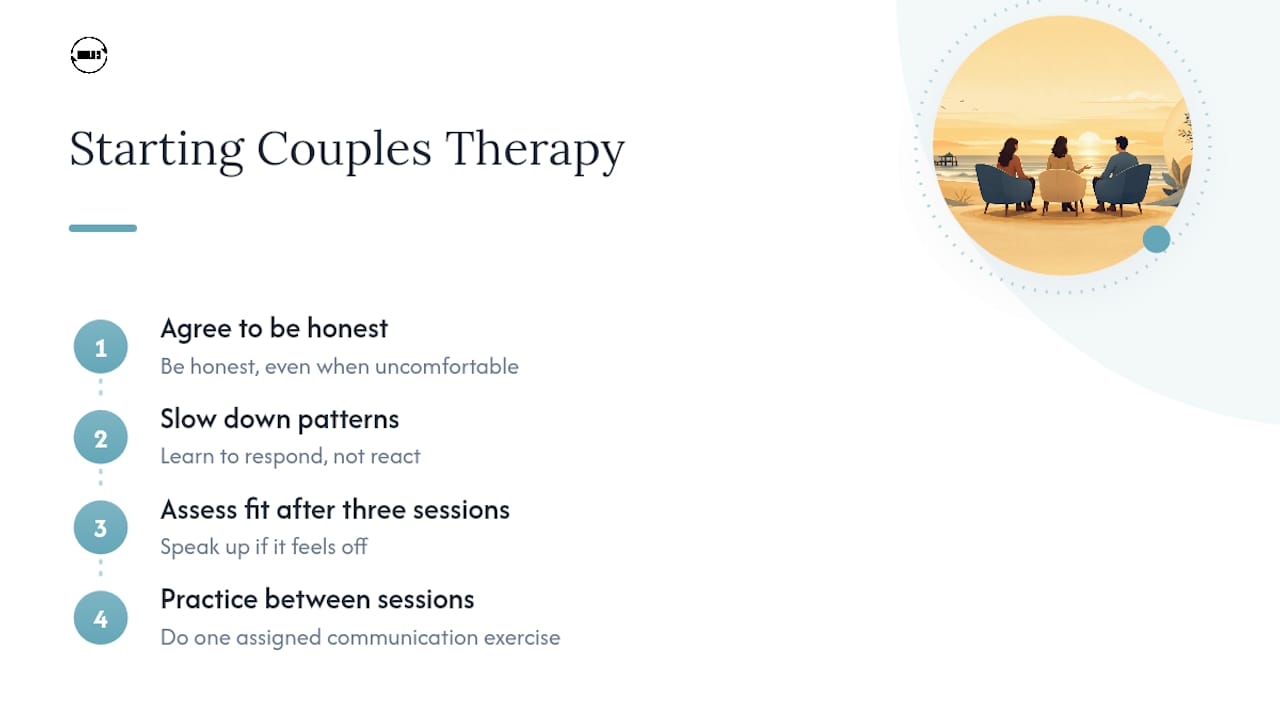
Starting therapy when a relationship feels strained takes courage, and the couples who get the most from it tend to arrive with one shared commitment: a willingness to be honest, even when it is uncomfortable. The work is not about performing wellness for a therapist. It is about slowing down the patterns that have calcified over months or years and learning to respond rather than react.
One thing that often gets overlooked is the value of the first few sessions as a calibration period. You are not just working on your relationship; you are also learning whether this particular therapist's style fits how you both process emotion. If something feels off after three sessions, say so. A good clinician will adjust, and if the fit genuinely is not right, they will help you find someone better suited.
Pro Tip: Between sessions, try one communication exercise your therapist assigns rather than waiting for the next appointment. Couples who practice outside sessions tend to consolidate gains faster.
Useful sources and further reading
- HIPAA: Guidance materials for consumers | HHS
- International Centre for Excellence in Emotionally Focused Therapy (ICEEFT)
- Mission and vision | WPATH
- TherapyPortal — Coastal2
- Therapist profile | Psychology Today
- Couples Therapy Services | Rush
- Couples Counselling — DEWY COUNSELLING
- Professional Counselling Services | Online & In-Person Therapy — DEWY COUNSELLING
Dewycounselling: flexible couples therapy without the waitlist
Cova Counseling, Passionately Living, and Virginia Beach Counseling & Wellness are all solid local choices. Dewycounselling offers something different: the same clinical depth in a format built around your schedule, whether that means a Thursday evening telehealth session from your living room or an in-person appointment that fits around work and family.

Dewycounselling's couples counselling services cover relationship conflict, communication breakdown, intimacy concerns, and the strain that anxiety, depression, or addiction places on a partnership. Membership packs and self-help modules mean the support does not have to stop between sessions. If you are ready to move from reading about therapy to actually doing it, book a session at dewycounselling.com and get started this week.
This article is general information, not professional advice. Confirm current provider availability, fees, and licensure with each practice directly, and consult a licensed clinician for guidance specific to your situation.